
Store Fulfillment App Market Report 2026
Global Outlook – By Component (Software, Services), By Fulfillment Model (Buy Online, Ship From Store (SFS), In-Store Order Picking And Staging, Returns Management), By Deployment Mode (Cloud-Based, On-Premises), By Application (Order Management, Inventory Management, Pick And Pack, Shipping Management, Customer Communication), By End-User Industry (Retail And E-Commerce, Grocery And Food Retail, Fashion And Apparel, Consumer Electronics, Healthcare And Pharmacy, Home Goods And Furniture) – Market Size, Trends, Strategies, and Forecast to 2030
Store Fulfillment App Market Overview
• Store Fulfillment App market size has reached to $3.90 billion in 2025 • Expected to grow to $8.53 billion in 2030 at a compound annual growth rate (CAGR) of 16.9% • Growth Driver: Rising E-commerce And Omnichannel Retailing Fueling The Growth Of The Market Due To Increasing Need For Efficient In-store Order Orchestration • Market Trend: Empowering Retailers With Enhanced Customer Insights View, Streamlined Fulfillment, And Real?Time Operational Visibility • North America was the largest region in 2025 and Asia-Pacific is the fastest growing region.What Is Covered Under Store Fulfillment App Market?
Store fulfillment app is a technology solution designed to streamline inventory management, order processing, and delivery operations within retail environments. It enables real time tracking of products across multiple locations and supports efficient coordination between stores and warehouses. The app enhances operational efficiency, reduces errors, and improves the speed and accuracy of fulfillment processes. The main components of store fulfillment app include software and services. Software refers to a set of programs, applications, and instructions that enable a computer or electronic device to perform specific tasks or functions. Different fulfillment models include buy online, ship from store (SFS), in-store order picking and staging, and returns management. Multiple deployment modes are cloud-based and on-premises. Various applications include order management, inventory management, pick and pack, shipping management, and customer communication, and they are used by several end-user industries such as retail and e-commerce, grocery and food retail, fashion and apparel, consumer electronics, healthcare and pharmacy, home goods and furniture.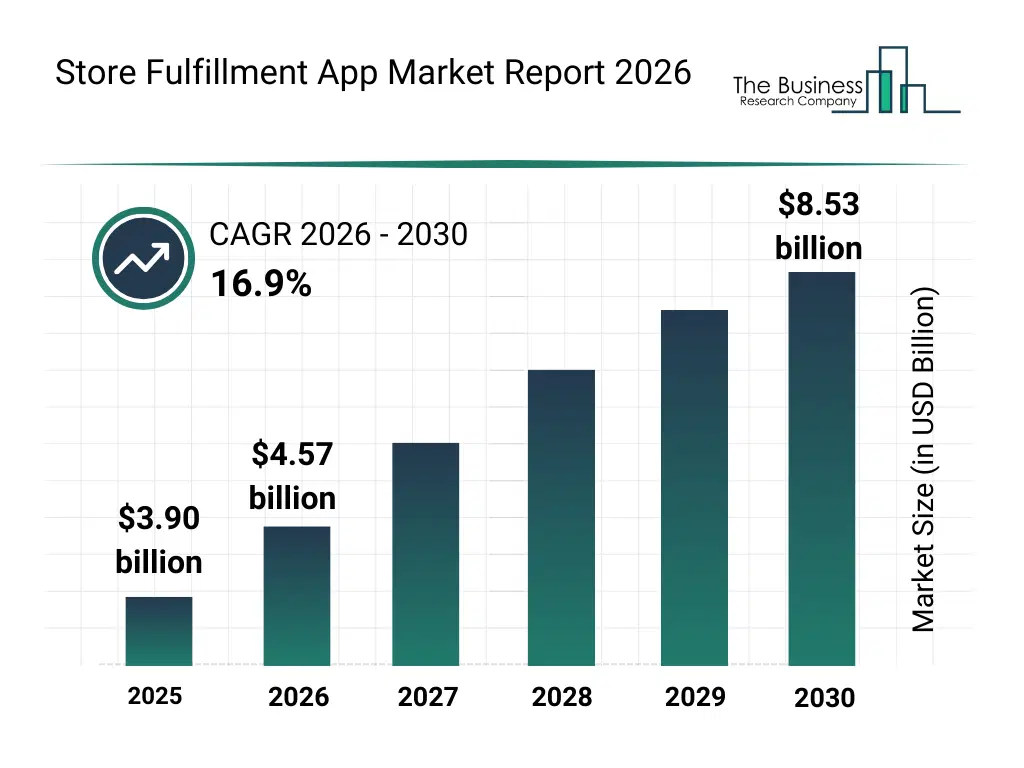
What Is The Store Fulfillment App Market Size and Share 2026?
The store fulfillment app market size has grown rapidly in recent years. It will grow from $3.90 billion in 2025 to $4.57 billion in 2026 at a compound annual growth rate (CAGR) of 17.2%. The growth in the historic period can be attributed to increasing demand for real-time inventory tracking, a rising need for efficient order processing, a growing focus on operational efficiency, expansion of e-commerce penetration, and increasing adoption of omnichannel retail strategies.What Is The Store Fulfillment App Market Growth Forecast?
The store fulfillment app market size is expected to see rapid growth in the next few years. It will grow to $8.53 billion in 2030 at a compound annual growth rate (CAGR) of 16.9%. The growth in the forecast period can be attributed to increasing adoption of cloud-based deployment, growing requirement for advanced analytics and reporting, rising integration with artificial intelligence (AI) and automation technologies, expansion of small and medium enterprises (SMEs) using cost-effective solutions, and increasing need for multi-location coordination. Major trends in the forecast period include innovation in cloud-based fulfillment solutions, advancement in artificial intelligence and machine learning, technology integration with internet of things (IoT) devices, development of omnichannel retail platforms, and investment in robotics and automation.
Global Store Fulfillment App Market Segmentation
1) By Component: Software, Services 2) By Fulfillment Model: Buy Online, Ship From Store (SFS), In-Store Order Picking And Staging, Returns Management 3) By Deployment Mode: Cloud-Based, On-Premises 4) By Application: Order Management, Inventory Management, Pick And Pack, Shipping Management, Customer Communication 5) By End-User Industry: Retail And E-Commerce, Grocery And Food Retail, Fashion And Apparel, Consumer Electronics, Healthcare And Pharmacy, Home Goods And Furniture Subsegments: 1) By Software: Order Management, Inventory Management, Pick And Pack, Shipping Management, Customer Communication, Reporting And Analytics, Integration And Implementation, Delivery Coordination 2) By Services: Implementation Services, Integration Services, Training And Support Services, Consulting Services, Maintenance And Upgrades Services, Customer Support ServicesWhat Is The Driver Of The Store Fulfillment App Market?
The rising adoption of e-commerce and omnichannel retailing is expected to drive the growth of the store fulfillment app market going forward. E-commerce and omnichannel retailing refer to the integration of online and physical channels so that customers can browse, purchase, and receive products seamlessly across websites, apps, and stores. The rise in adoption of e-commerce and omnichannel retailing is due to consumers increasingly expecting convenient anytime shopping with seamless consistent experiences across online stores mobile apps and physical outlets. Store fulfillment apps support adoption of e-commerce and omnichannel retailing by orchestrating orders across channels, guiding store associates through picking and packing, and optimizing ship-from-store or pickup workflows. For instance, in January 2025, according to the UK Office for National Statistics, a UK-based government agency, online spending values in Great Britain in December 2024 were 1.7% higher than in December 2023, highlighting year-on-year growth in internet retail channel spending. Therefore, the rise in e-commerce and omnichannel retailing is boosting demand for store fulfillment apps.Key Players In The Global Store Fulfillment App Market
Major companies operating in the store fulfillment app market are Microsoft Corporation, Oracle Corporation, Honeywell International Inc., SAP Societas Europaea, Salesforce Inc., Shopify Inc., Zebra Technologies Corporation, Radial Inc., Blue Yonder Group Inc., Pitney Bowes Inc., Manhattan Associates Inc., TrueCommerce Inc., Aptos Inc., Kibo Commerce LLC, Shippo, NewStore Inc., OrderDynamics, Fluent Commerce Pvt Ltd., ShipStation LLC, Logicbroker
This chart is for illustrative purposes; the full report includes a detailed competitor analysis and comprehensive overview of the top 10 companies in the market.
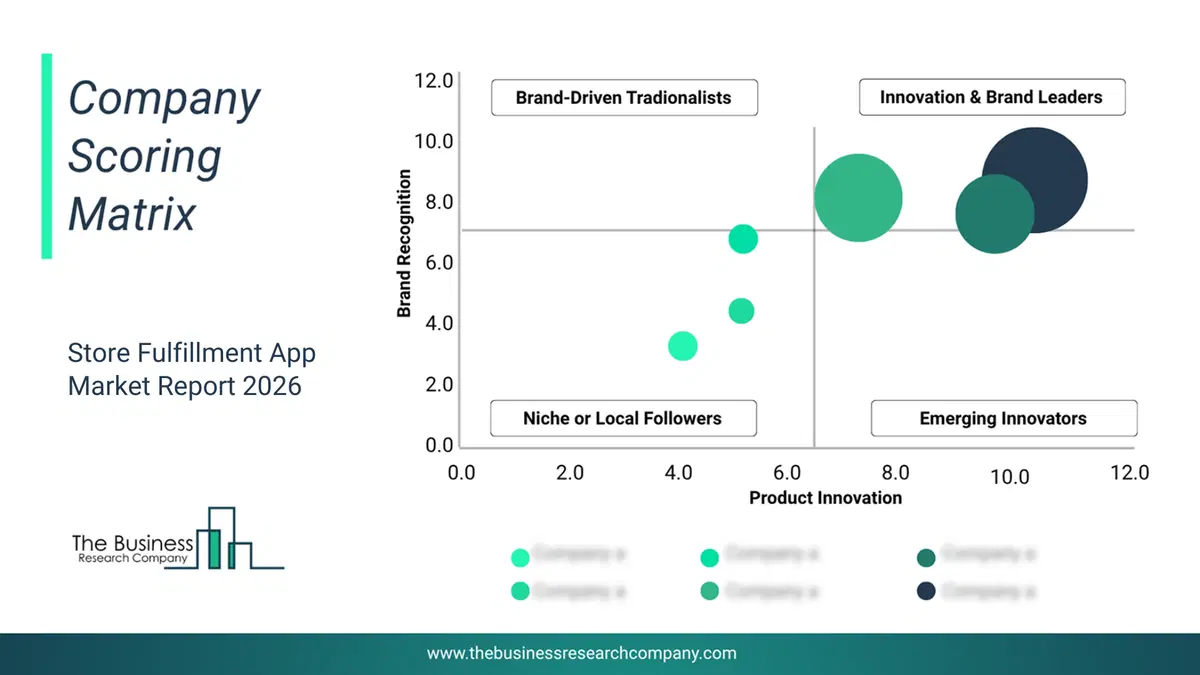
This chart maps companies by product innovation and brand strength, with bubble size indicating relative revenue, helping identify market leaders, challengers, and niche players. This is an illustrative chart; the full report provides a complete and accurate competitive analysis.
Global Store Fulfillment App Market Trends and Insights
Major companies operating in the store fulfillment app market are focusing on developing advanced product features, such as enhanced customer insights view, to improve order accuracy, personalize shopper experiences, and drive operational efficiency across omnichannel retail environments. Enhanced customer insights view is the capability of a fulfillment platform to aggregate and display rich customer data in a unified dashboard, enabling retailers to tailor fulfillment strategies and improve service outcomes as demand grows. For instance, in January 2025, Aptos LLC, a US-based provider of unified commerce solutions, introduced Aptos ONE 2025.1. The platform update features Artificial Intelligence (AI)-powered customer insight summarizations and product recommendations displayed during inquiry lookups, alongside new clienteling capabilities that surface visual purchase history and special occasion data to drive engagement. The solution also integrates store fulfillment functions and pop-up associate messaging to streamline operations and elevate the in-store experience through a single, mobile-native application.What Are Latest Mergers And Acquisitions In The Store Fulfillment App Market?
In October 2024, The Descartes Systems Group Inc., a Canada-based provider of logistics and supply chain management solutions, acquired Sellercloud LLC for approximately $110 million. With this acquisition, Descartes sought to expand its ecommerce suite and strengthen its inventory and order management capabilities by integrating Sellercloud’s omnichannel platform, which enables merchants to synchronize products, inventory, and sales across multiple marketplaces and sales channels. Sellercloud LLC is a US-based provider of inventory management and order processing software for ecommerce retailers, distributors, and manufacturers and works as store fulfillment platform.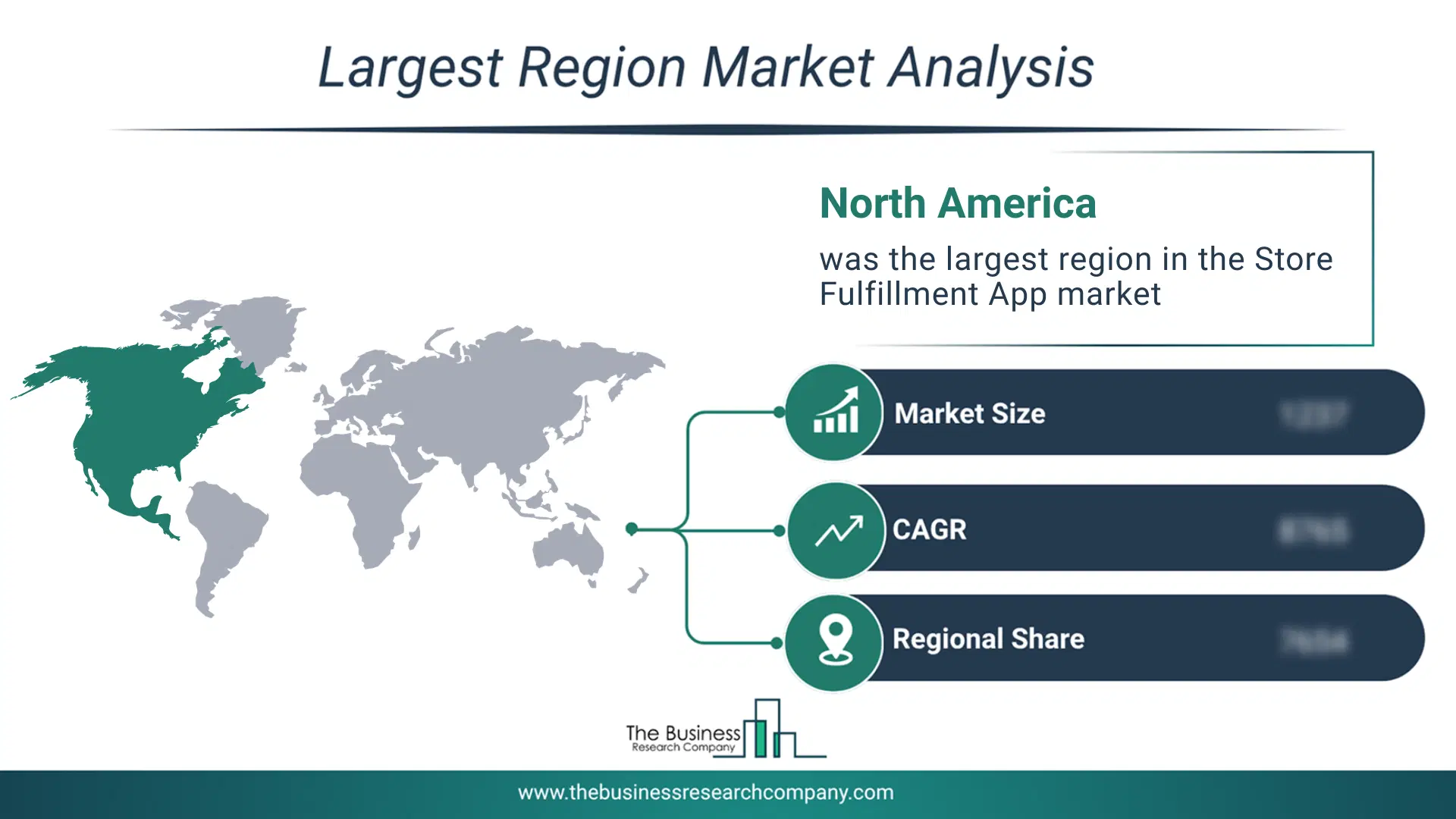
Regional Insights
North America was the largest region in the store fulfillment app market in 2025. Asia-Pacific is expected to be the fastest-growing region in the forecast period. The regions covered in this market report are Asia-Pacific, South East Asia, Western Europe, Eastern Europe, North America, South America, Middle East, Africa. The countries covered in this market report are Australia, Brazil, China, France, Germany, India, Indonesia, Japan, Taiwan, Russia, South Korea, UK, USA, Canada, Italy, Spain.What Defines the Store Fulfillment App Market?
The store fulfillment app market includes revenues earned by entities by providing services such as inventory management services, order processing services, real time tracking services, delivery coordination services, reporting and analytics services, integration and implementation services, support and maintenance services. The market value includes the value of related goods sold by the service provider or included within the service offering. Only goods and services traded between entities or sold to end consumers are included. The store fulfillment app market consists of sales of cloud-based fulfillment software, mobile fulfillment applications, inventory tracking tools, order management systems, warehouse management solutions, automated picking and packing tools, reporting and analytics dashboards. Values in this market are ‘factory gate’ values, that is the value of goods sold by the manufacturers or creators of the goods, whether to other entities (including downstream manufacturers, wholesalers, distributors and retailers) or directly to end customers. The value of goods in this market includes related services sold by the creators of the goods.How is Market Value Defined and Measured?
The market value is defined as the revenues that enterprises gain from the sale of goods and/or services within the specified market and geography through sales, grants, or donations in terms of the currency (in USD unless otherwise specified). The revenues for a specified geography are consumption values that are revenues generated by organizations in the specified geography within the market, irrespective of where they are produced. It does not include revenues from resales along the supply chain, either further along the supply chain or as part of other products.
This chart presents market attractiveness based on a quantitative evaluation of growth, competition, strategic alignment, and risk, offering a clear view of opportunity areas for decision-making. This chart is for illustrative purposes; the full report contains the complete analysis.

This chart highlights the Total Addressable Market (TAM) by estimating the maximum revenue opportunity using an assumption-driven approach, supporting strategic planning and opportunity sizing across markets. The chart is illustrative; the full report provides a more comprehensive analysis.
What Key Data and Analysis Are Included in the Store Fulfillment App Market Report 2026?
The store fulfillment app market research report is one of a series of new reports from The Business Research Company that provides market statistics, including industry global market size, regional shares, competitors with the market share, detailed market segments, market trends and opportunities, and any further data you may need to thrive in the store fulfillment app industry. The market research report delivers a complete perspective of everything you need, with an in-depth analysis of the current and future state of the industry.Store Fulfillment App Market Report Forecast Analysis
| Report Attribute | Details |
|---|---|
| Market Size Value In 2026 | $4.57 billion |
| Revenue Forecast In 2030 | $8.53 billion |
| Growth Rate | CAGR of 17.2% from 2026 to 2030 |
| Base Year For Estimation | 2025 |
| Actual Estimates/Historical Data | 2020-2025 |
| Forecast Period | 2026 - 2030 |
| Market Representation | Revenue in USD Billion and CAGR from 2026 to 2030 |
| Segments Covered | Component, Fulfillment Model, Deployment Mode, Application, End-User Industry |
| Regional Scope | Asia-Pacific, Western Europe, Eastern Europe, North America, South America, Middle East, Africa |
| Country Scope | The countries covered in the report are Australia, Brazil, China, France, Germany, India, Indonesia, Japan, Taiwan, Russia, South Korea, UK, USA, Canada, Italy, Spain. |
| Key Companies Profiled | Microsoft Corporation, Oracle Corporation, Honeywell International Inc., SAP Societas Europaea, Salesforce Inc., Shopify Inc., Zebra Technologies Corporation, Radial Inc., Blue Yonder Group Inc., Pitney Bowes Inc., Manhattan Associates Inc., TrueCommerce Inc., Aptos Inc., Kibo Commerce LLC, Shippo, NewStore Inc., OrderDynamics, Fluent Commerce Pvt Ltd., ShipStation LLC, Logicbroker |
| Customization Scope | Request for Customization |
| Pricing And Purchase Options | Explore Purchase Options |