
Telecom Edge Load Balancer Market Report 2026
Global Outlook – By Component (Hardware, Software, Services), By Deployment Mode (On-Premises, Cloud, Hybrid), By Application (Network Function Virtualization, Content Delivery Networks, Internet Of Things (IoT), 5G Networks, Other Applications), By End-User (Telecom Operators, Enterprises, Data Centers, Other End-Users) – Market Size, Trends, Strategies, and Forecast to 2030
Telecom Edge Load Balancer Market Overview
• Telecom Edge Load Balancer market size has reached to $1.47 billion in 2025 • Expected to grow to $4.22 billion in 2030 at a compound annual growth rate (CAGR) of 23.4% • Growth Driver: Rising Deployment Of 5G Networks Fuelling The Growth Of The Market Amid Increasing Demand For High-Speed, Low-Latency Connectivity • Market Trend: Integration Of Reverse Hypertext Transfer Protocol To Improve Network Efficiency • North America was the largest region in 2025 and Asia-Pacific is the fastest growing region.What Is Covered Under Telecom Edge Load Balancer Market?
A telecom edge load balancer is a network device or software function placed at the edge of a telecom network, near user access points or cell sites, that distributes traffic across multiple servers or service nodes. It examines incoming sessions and flows in real time, selecting the most suitable edge compute or network function instance based on factors like capacity, latency, and health to maintain smooth network performance. By efficiently balancing workloads at the edge, it helps reduce latency, enhance reliability, and support the seamless scaling of services such as 5G networks, Internet of Things (IoT) applications, and augmented or virtual reality (AR/VR) experiences. The main components of telecom edge load balancers include hardware, software, and services. Various deployment modes include on-premises, cloud, and hybrid and is applied for network function virtualization, content delivery networks, internet of things (iot), 5G networks, and others. It is used by several end-users including telecom operators, enterprises, data centers, and others.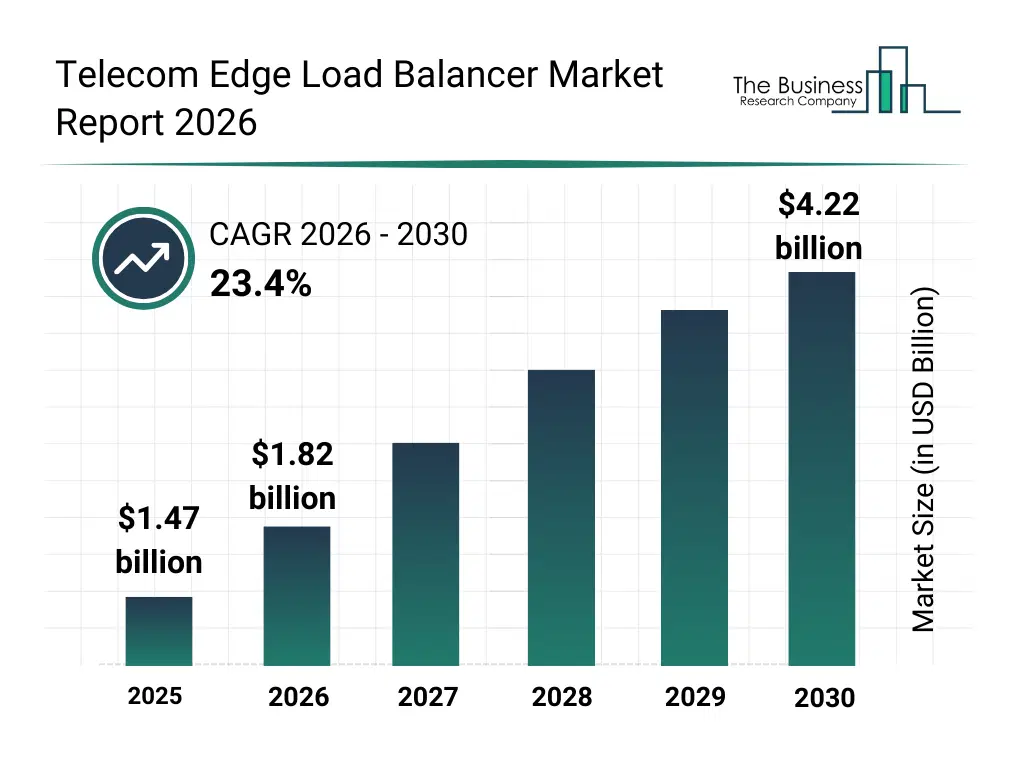
What Is The Telecom Edge Load Balancer Market Size and Share 2026?
The telecom edge load balancer market size has grown exponentially in recent years. It will grow from $1.47 billion in 2025 to $1.82 billion in 2026 at a compound annual growth rate (CAGR) of 23.7%. The growth in the historic period can be attributed to growth of 5G network rollouts, increase in edge compute deployments, rising demand for low latency services, complexity of distributed network functions, need to improve service reliability at the edge.What Is The Telecom Edge Load Balancer Market Growth Forecast?
The telecom edge load balancer market size is expected to see exponential growth in the next few years. It will grow to $4.22 billion in 2030 at a compound annual growth rate (CAGR) of 23.4%. The growth in the forecast period can be attributed to AI-driven traffic optimization and predictive scaling, wider adoption of cloud-native network functions, integration with network slicing and qos policies, expansion of iot and ar/vr edge workloads, greater focus on edge security and compliance. Major trends in the forecast period include cloud-native edge load balancing for 5G core and ran, real-time traffic steering using application-aware policies, service mesh integration for edge network functions, multi-access edge computing (mec) scaling and resilience, security-aware load balancing with zero trust controls.
Global Telecom Edge Load Balancer Market Segmentation
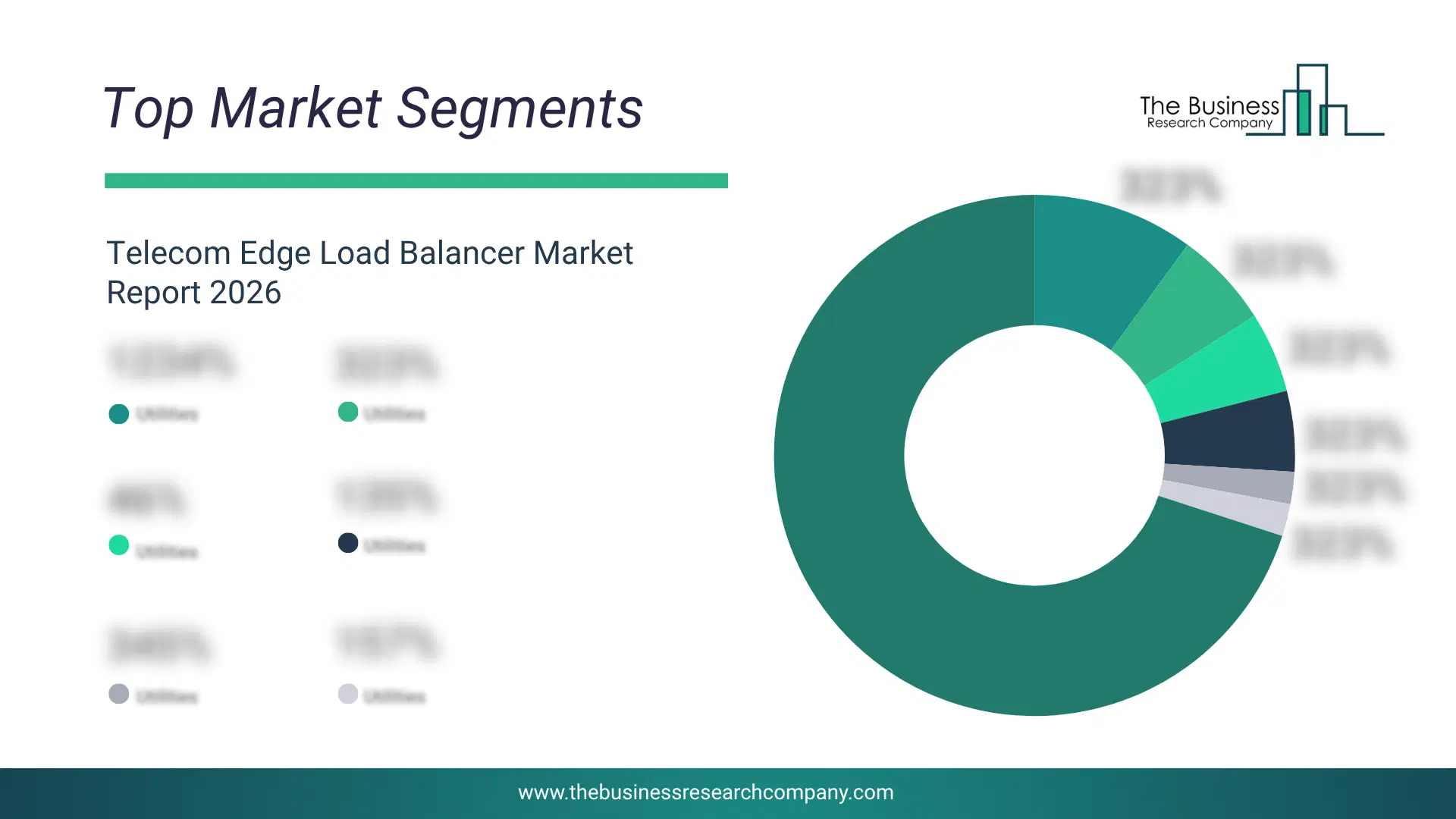
1) By Component: Hardware, Software, Services 2) By Deployment Mode: On-Premises, Cloud, Hybrid 3) By Application: Network Function Virtualization, Content Delivery Networks, Internet Of Things (IoT), 5G Networks, Other Applications 4) By End-User: Telecom Operators, Enterprises, Data Centers, Other End-Users Subsegments: 1) By Hardware: Load Balancing Appliances, Edge Routers, Switches, Network Interface Cards, Signal Processing Units, Performance Monitoring Devices 2) By Software: Load Balancing Algorithms, Traffic Management Software, Network Orchestration Tools, Application Delivery Controllers, Analytics And Monitoring Software, Security And Compliance Software 3) By Services: Deployment And Integration Services, Consulting And Advisory Services, Managed Load Balancing Services, Maintenance And Support Services, Training And Certification Services, Network Optimization ServicesWhat Is The Driver Of The Telecom Edge Load Balancer Market?
The rising deployment of 5G networks is expected to propel the growth of the telecom edge load balancer market going forward. 5G networks refer to the fifth generation of mobile network technology designed to deliver ultra-fast data speeds, low latency, and massive connectivity for advanced digital services. 5G networks are expanding due to the increasing demand for high-capacity communication infrastructure that supports data-intensive applications such as internet of things (IoT), cloud computing, and edge analytics. Telecom edge load balancers support the deployment of 5G networks by efficiently distributing traffic across distributed edge nodes to ensure ultra-low latency, high reliability, and seamless scalability for real-time, bandwidth-intensive applications. For instance, in July 2024, according to the Organisation for Economic Co-operation and Development (OECD), a France-based intergovernmental organization, 5G comprised 28% of all mobile broadband subscriptions across OECD countries in 2023, representing a 9% increase compared to the end of 2022. Therefore, the rising deployment of 5G networks is driving the growth for the telecom edge load balancer industry.Key Players In The Global Telecom Edge Load Balancer Market
Major companies operating in the telecom edge load balancer market are Amazon.com Inc., Google LLC, Microsoft Corporation, Cisco Systems Inc., Telefonaktiebolaget LM Ericsson, Enea AB, Equinix Inc., Fortinet Inc., AkamAI Technologies Inc., Cloud Software Group Inc., F5 Inc., Cloudflare Inc., Fastly Inc., Barracuda Networks Inc., Radware Ltd., A10 Networks Inc., Array Networks Inc., HAProxy Technologies LLC, Inlab Networks GmbH, AVANU LLC.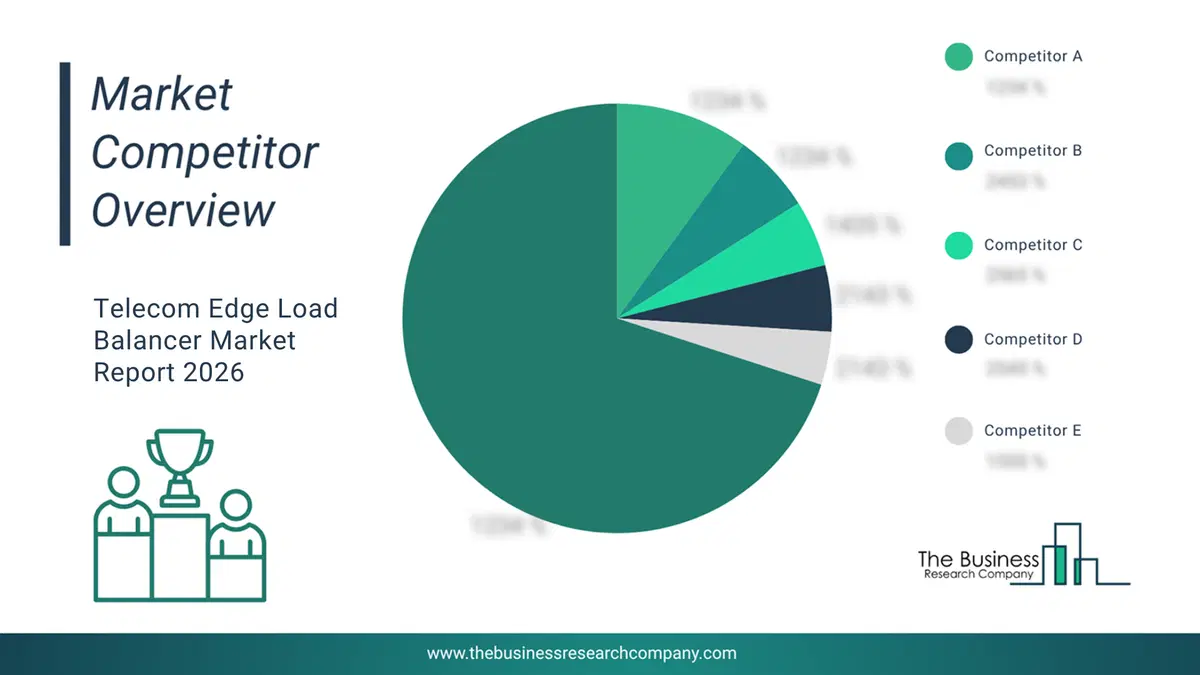
This chart is for illustrative purposes; the full report includes a detailed competitor analysis and comprehensive overview of the top 10 companies in the market.
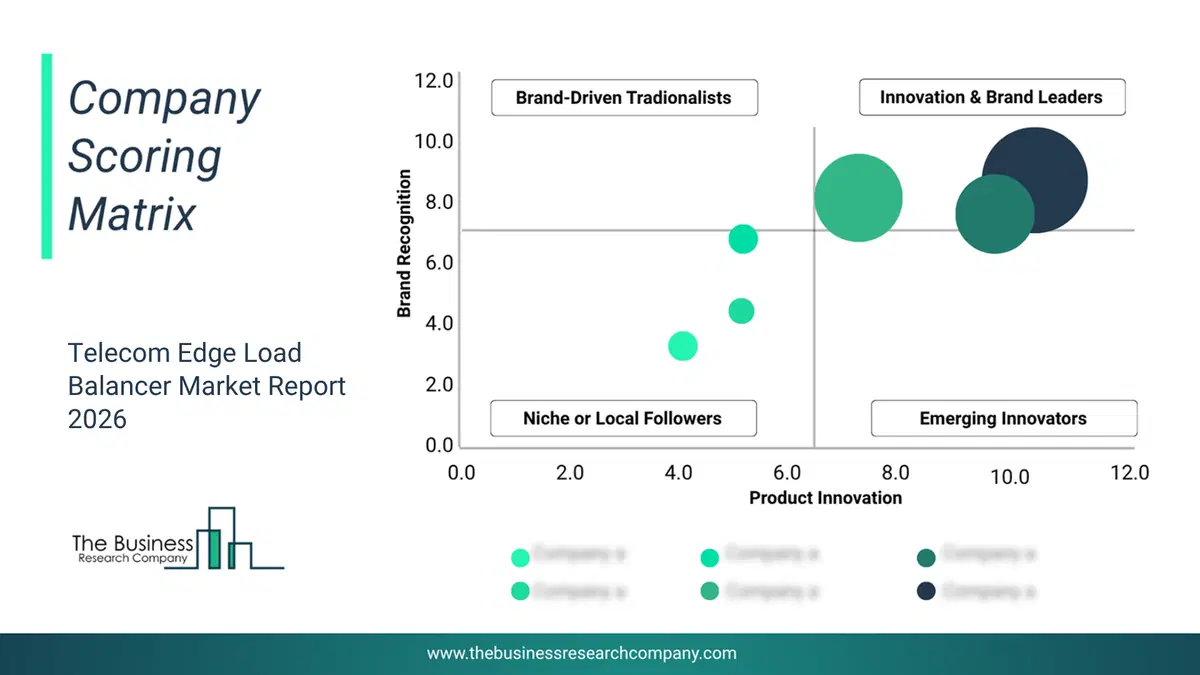
This chart maps companies by product innovation and brand strength, with bubble size indicating relative revenue, helping identify market leaders, challengers, and niche players. This is an illustrative chart; the full report provides a complete and accurate competitive analysis.
Global Telecom Edge Load Balancer Market Trends and Insights
Major companies operating in the telecom edge load balancer market are focusing on incorporating reverse hypertext transfer protocol (HTTP) to enhance network efficiency, low-latency communication, and real-time edge management. Reverse HTTP is an advanced connection management technology that allows a datacentre load balancer to initiate outbound connections to edge load balancer instances located behind firewalls or private networks, using those persistent channels for bidirectional traffic and dynamic service registration. For instance, in December 2023, HAProxy Technologies, a France-based provider of high-performance load balancing and application delivery solutions, launched HAProxy 2.9, a reverse HTTP–enabled platform designed to optimize communication between datacentre cores and edge nodes through enhanced protocol support and advanced observability tools. HAProxy 2.9 enhances traffic management efficiency, reliability across distributed edge deployments, and the scalability of telecom-edge infrastructures.What Are Latest Mergers And Acquisitions In The Telecom Edge Load Balancer Market?
In August 2023, Radware, an Israel-based provider of cybersecurity and application delivery solutions, partnered with Spark NZ to deliver Radware’s cloud-based application and network security services to enterprise and carrier customers across New Zealand. Through this collaboration, Spark NZ aims to enhance its network protection capabilities and strengthen service reliability by integrating Radware’s advanced cloud distributed denial of service (DDoS) mitigation and application protection technologies within its telecom infrastructure. Spark NZ is a New Zealand-based telecommunications and digital services company offering broadband, mobile, and ICT solutions.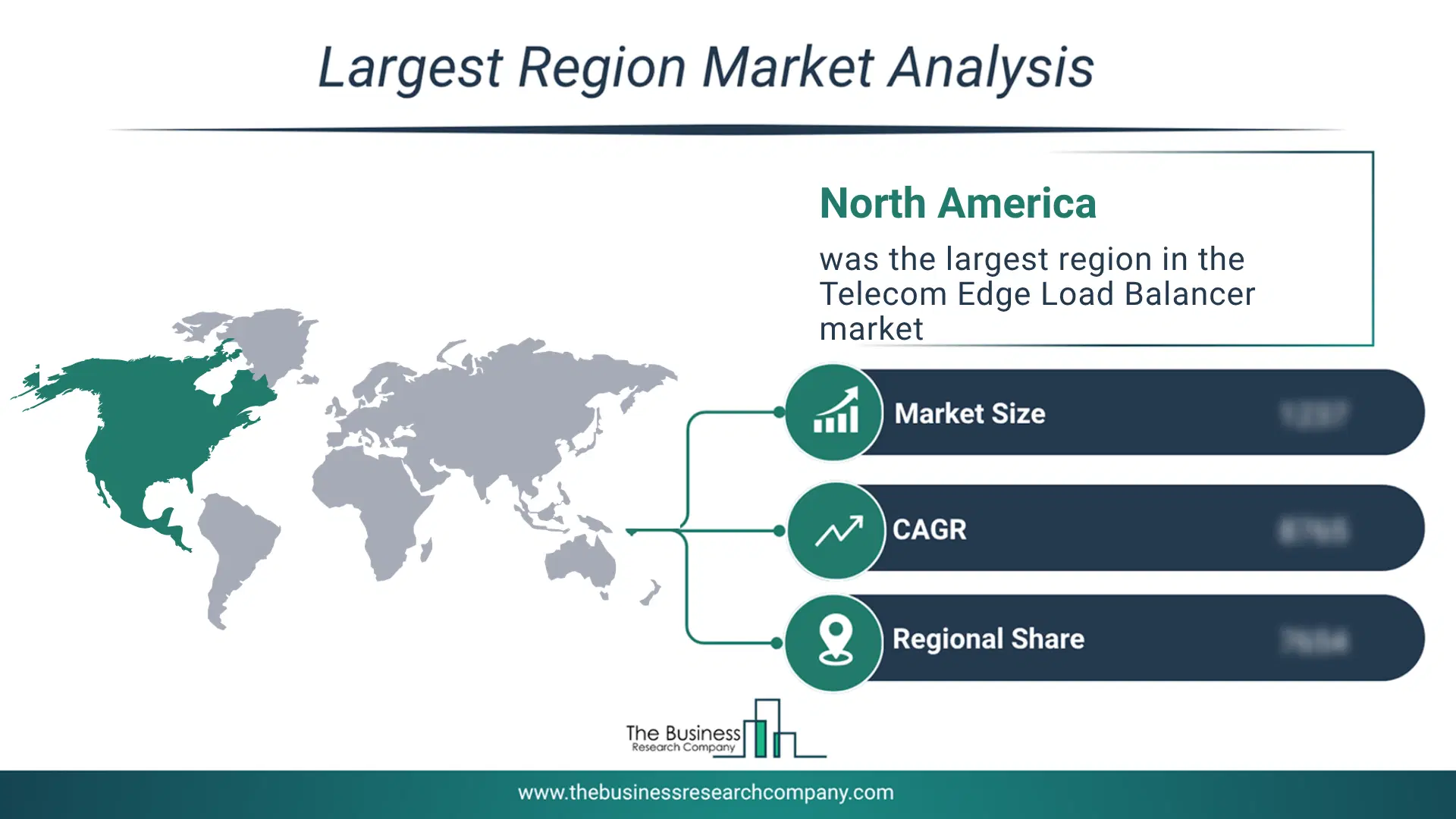
Regional Insights
North America was the largest region in the telecom edge load balancer market in 2025. Asia-Pacific is expected to be the fastest-growing region in the forecast period. The regions covered in this market report are Asia-Pacific, South East Asia, Western Europe, Eastern Europe, North America, South America, Middle East, Africa. The countries covered in this market report are Australia, Brazil, China, France, Germany, India, Indonesia, Japan, Taiwan, Russia, South Korea, UK, USA, Canada, Italy, Spain.What Defines the Telecom Edge Load Balancer Market?
The telecom edge load balancer market consists of revenues earned by entities by providing services such as system configuration services, performance testing services, interoperability assessment services, cloud migration services, edge infrastructure management services, and technical support and troubleshooting services. The market value includes the value of related goods sold by the service provider or included within the service offering. The telecom edge load balancer market also includes sales of automated failover systems, network telemetry systems, and protocol translation devices. Values in this market are ‘factory gate’ values, that is the value of goods sold by the manufacturers or creators of the goods, whether to other entities (including downstream manufacturers, wholesalers, distributors and retailers) or directly to end customers. The value of goods in this market includes related services sold by the creators of the goods.How is Market Value Defined and Measured?
The market value is defined as the revenues that enterprises gain from the sale of goods and/or services within the specified market and geography through sales, grants, or donations in terms of the currency (in USD unless otherwise specified). The revenues for a specified geography are consumption values that are revenues generated by organizations in the specified geography within the market, irrespective of where they are produced. It does not include revenues from resales along the supply chain, either further along the supply chain or as part of other products.
This chart presents market attractiveness based on a quantitative evaluation of growth, competition, strategic alignment, and risk, offering a clear view of opportunity areas for decision-making. This chart is for illustrative purposes; the full report contains the complete analysis.

This chart highlights the Total Addressable Market (TAM) by estimating the maximum revenue opportunity using an assumption-driven approach, supporting strategic planning and opportunity sizing across markets. The chart is illustrative; the full report provides a more comprehensive analysis.
What Key Data and Analysis Are Included in the Telecom Edge Load Balancer Market Report 2026?
The telecom edge load balancer market research report is one of a series of new reports from The Business Research Company that provides market statistics, including industry global market size, regional shares, competitors with the market share, detailed market segments, market trends and opportunities, and any further data you may need to thrive in the telecom edge load balancer industry. The market research report delivers a complete perspective of everything you need, with an in-depth analysis of the current and future state of the industry.Telecom Edge Load Balancer Market Report Forecast Analysis
| Report Attribute | Details |
|---|---|
| Market Size Value In 2026 | $1.82 billion |
| Revenue Forecast In 2030 | $4.22 billion |
| Growth Rate | CAGR of 23.4% from 2026 to 2030 |
| Base Year For Estimation | 2025 |
| Actual Estimates/Historical Data | 2020-2025 |
| Forecast Period | 2026 - 2030 |
| Market Representation | Revenue in USD Billion and CAGR from 2026 to 2030 |
| Segments Covered | Component, Deployment Mode, Application, End-User |
| Regional Scope | Asia-Pacific, Western Europe, Eastern Europe, North America, South America, Middle East, Africa |
| Country Scope | The Countries Covered In This Market Report Are Australia, Brazil, China, France, Germany, India, Indonesia, Japan, Taiwan, Russia, South Korea, Uk, Usa, Canada, Italy, Spain. |
| Key Companies Profiled | Amazon.com Inc., Google LLC, Microsoft Corporation, Cisco Systems Inc., Telefonaktiebolaget LM Ericsson, Enea AB, Equinix Inc., Fortinet Inc., AkamAI Technologies Inc., Cloud Software Group Inc., F5 Inc., Cloudflare Inc., Fastly Inc., Barracuda Networks Inc., Radware Ltd., A10 Networks Inc., Array Networks Inc., HAProxy Technologies LLC, Inlab Networks GmbH, AVANU LLC. |
| Customization Scope | Request for Customization |
| Pricing And Purchase Options | Explore Purchase Options |