

Aerospace And Defense Propulsion System Market Report 2026
Global Outlook – By Type (Air-Breathing, Non-Air-Breathing), By Application (Missiles, Aircraft, Spacecraft, Unnamed Aerial Vehicles (UAVs)), By End-Use (Commercial, Government And Military) – Market Size, Trends, Strategies, and Forecast to 2030
Aerospace And Defense Propulsion System Market Overview
• Aerospace And Defense Propulsion System market size has reached to $285.45 billion in 2025 • Expected to grow to $394.14 billion in 2030 at a compound annual growth rate (CAGR) of 6.7% • Growth Driver: The Expansion Of Commercial Air Travel Is Fueling The Growth Of The Market Due To Increasing Demand For Efficient And Sustainable Propulsion Systems • Market Trend: Advancements In High-Voltage Power Distribution For Hybrid-Electric Aircraft Propulsion • North America was the largest region in 2025.What Is Covered Under Aerospace And Defense Propulsion System Market?
An aerospace and defense propulsion system refers to the set of technologies, machinery, and components designed to generate thrust, enabling the movement of aircraft, spacecraft, missiles, and other defense vehicles through air or space. It plays a crucial role in achieving lift-off, sustained flight, maneuverability, and mission success in both civilian and military applications. The main types of aerospace and defense propulsion system are air-breathing and non-air-breathing. Air-breathing propulsion systems use atmospheric oxygen for combustion, making them efficient for high-speed aircraft and missiles across varying speeds and altitudes. It is applicable in various applications such as missiles, aircraft, spacecraft, and unmanned aerial vehicles (UAVs) and is used by several end-users, including commercial, government, and military.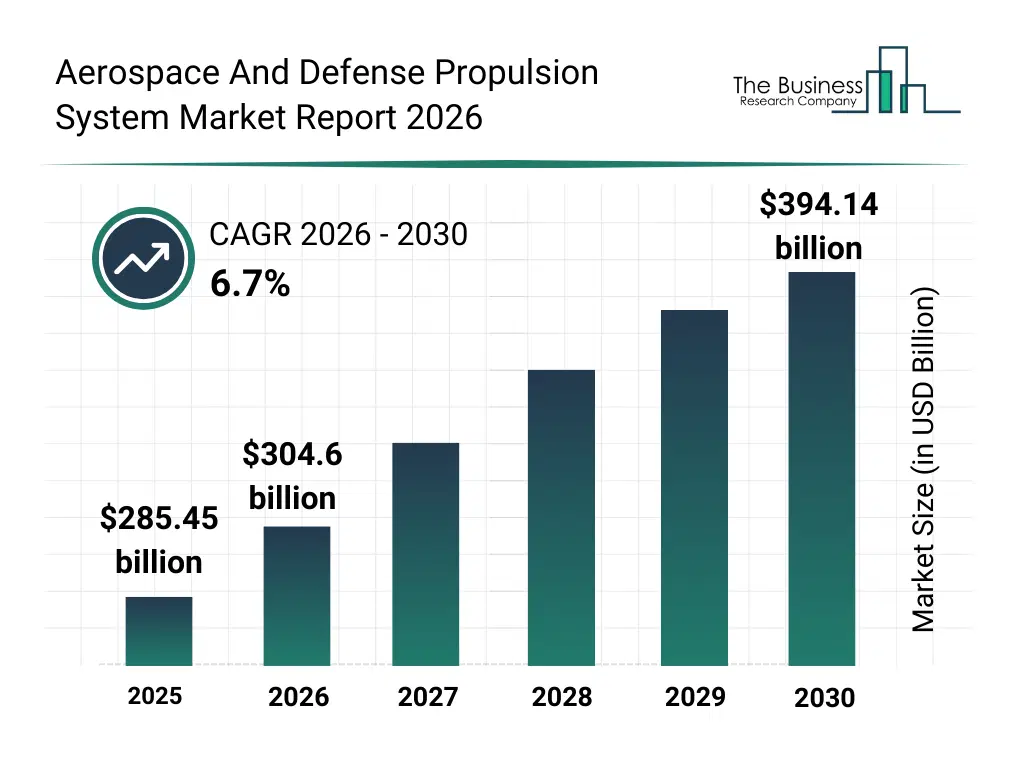
What Is The Aerospace And Defense Propulsion System Market Size and Share 2026?
The aerospace and defense propulsion system market size has grown strongly in recent years. It will grow from $285.45 billion in 2025 to $304.6 billion in 2026 at a compound annual growth rate (CAGR) of 6.7%. The growth in the historic period can be attributed to advancements in turbojet and turboshaft engine technologies, growth in military and commercial aviation fleets, development of electric propulsion prototypes for aerospace applications, government funding and defense contracts driving propulsion r&d, expansion of maintenance and overhaul services for propulsion systems.What Is The Aerospace And Defense Propulsion System Market Growth Forecast?
The aerospace and defense propulsion system market size is expected to see strong growth in the next few years. It will grow to $394.14 billion in 2030 at a compound annual growth rate (CAGR) of 6.7%. The growth in the forecast period can be attributed to rising demand for fuel-efficient and low-emission propulsion systems, growth in electric and hybrid propulsion adoption for aircraft and spacecraft, advancements in high-thrust engines for next-generation defense vehicles, increasing investment in space propulsion technologies, integration of ai and predictive maintenance for propulsion system optimization. Major trends in the forecast period include advancement in next-generation hypersonic propulsion, increased adoption of reusable propulsion systems for cost efficiency, growth in electric and hybrid propulsion solutions for space and uav platforms, modernization of defense fleets driving propulsion upgrades, rising focus on lightweight materials and thermal efficiency improvement.
Global Aerospace And Defense Propulsion System Market Segmentation
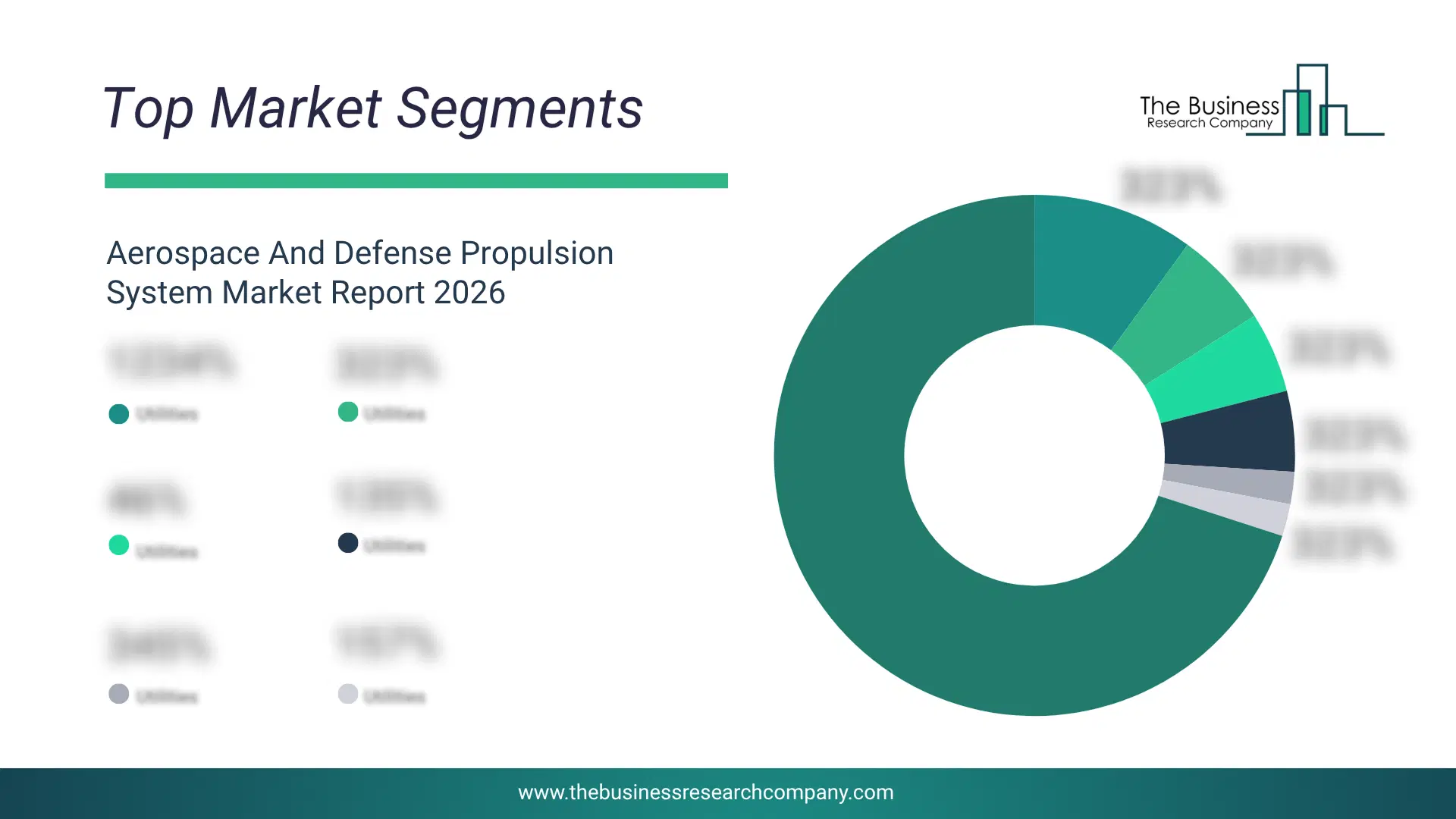
1) By Type: Air-Breathing, Non-Air-Breathing 2) By Application: Missiles, Aircraft, Spacecraft, Unnamed Aerial Vehicles (UAVs) 3) By End-Use: Commercial, Government And Military Subsegments: 1) By Air-Breathing: Turbojet Engines, Turbofan Engines, Ramjet Engines, Scramjet Engines, Pulsejet Engines 2) By Non-Air-Breathing: Solid Propellant Engines, Liquid Propellant Engines, Hybrid Propellant Engines, Nuclear Thermal Propulsion, Electric PropulsionWhat Is Driver Of The Aerospace And Defense Propulsion System Market?
The expansion of commercial air travel is expected to propel the growth of the aerospace and defense propulsion system market going forward. Commercial air travel involves the use of aircraft to transport passengers or cargo for a fee, usually operated by airline companies. Commercial air travel is increasing due to economic growth, which boosts disposable income, enabling more people to afford business and leisure flights. The growth of commercial air travel boosts the demand for efficient and sustainable propulsion systems in aerospace and defense. Airlines' focus on increasing capacity and lowering emissions accelerates the development of advanced, eco-friendly propulsion technologies. For instance, in March 2025, according to the Bureau of Transportation Statistics, a US-based government agency, US airlines carried 926 million passengers in 2024, marking a 5.2% increase from 881 million in 2023. Therefore, the expansion of commercial air travel is driving the growth of the aerospace and defense propulsion system industry.Key Players In The Global Aerospace And Defense Propulsion System Market
Major companies operating in the aerospace and defense propulsion system market are Lockheed Martin Corporation, Airbus SE, General Electric Company, Northrop Grumman Corporation, Honeywell International Inc., Pratt & Whitney, Safran S.A., L3Harris Technologies Inc., IHI Corporation, SpaceX, MTU Aero Engines AG, Moog Inc., Blue Origin LLC, ArianeGroup, ITP Aero, Rocket Lab USA Inc., Ursa Major Technologies Inc., Dawn Aerospace, Astra Space Inc., HyImpulse Technologies GmbH, BluShift Aerospace Inc.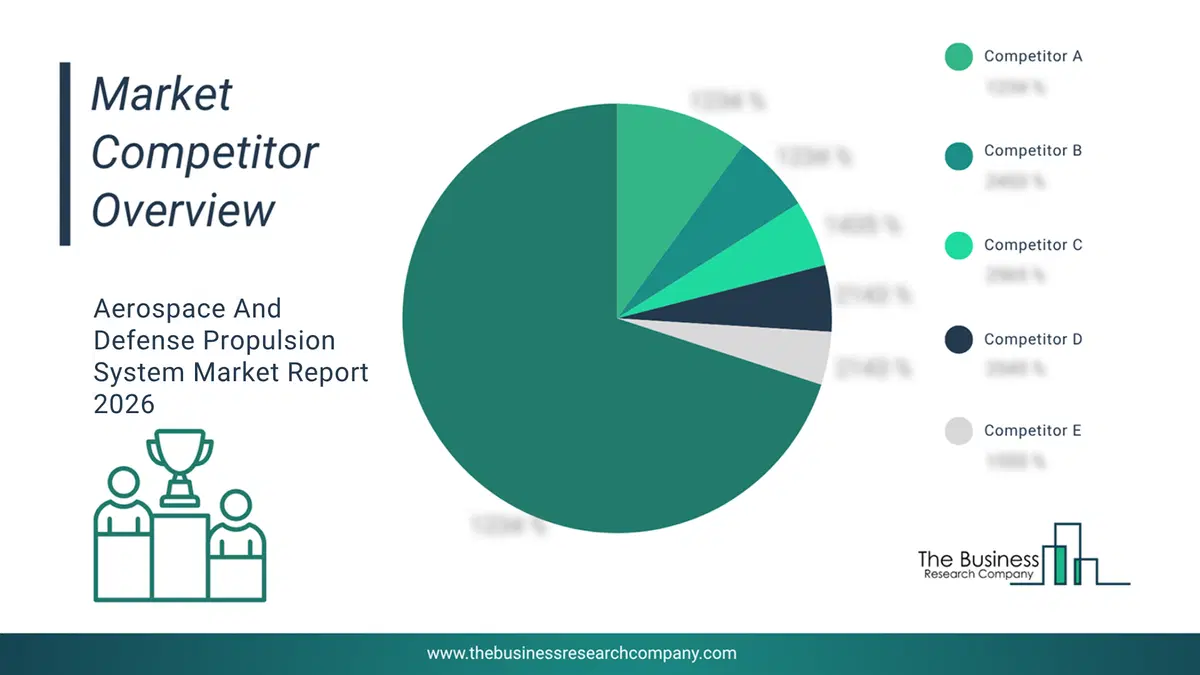
This chart is for illustrative purposes; the full report includes a detailed competitor analysis and comprehensive overview of the top 10 companies in the market.
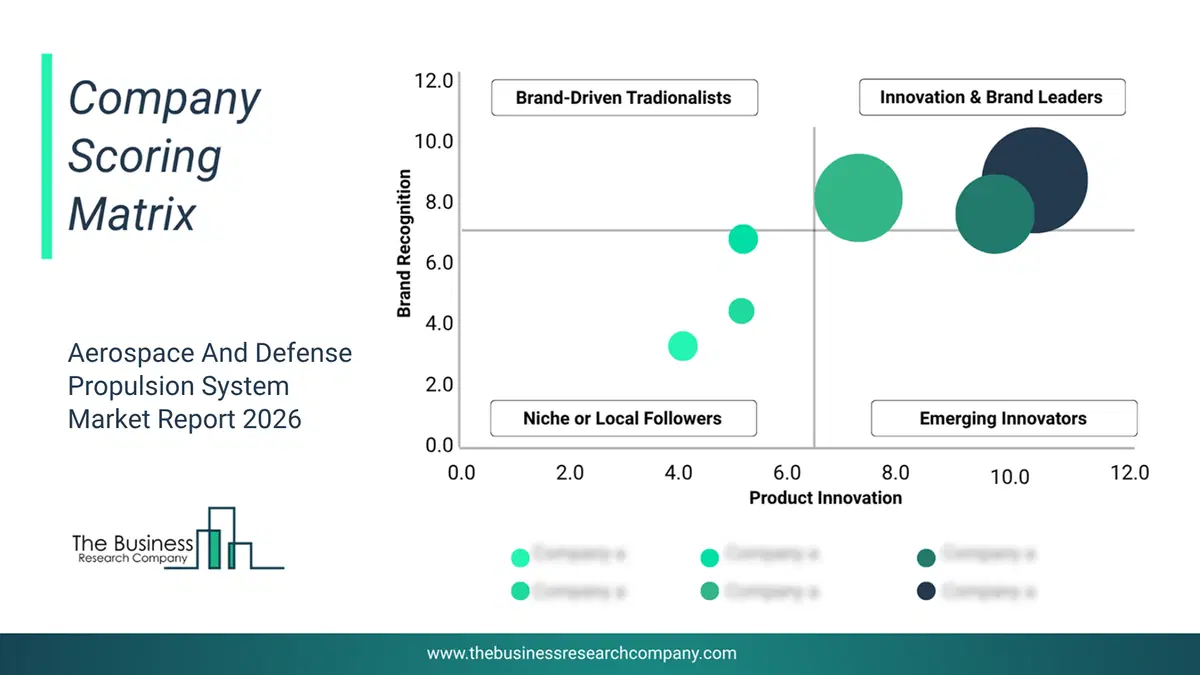
This chart maps companies by product innovation and brand strength, with bubble size indicating relative revenue, helping identify market leaders, challengers, and niche players. This is an illustrative chart; the full report provides a complete and accurate competitive analysis.
Global Aerospace And Defense Propulsion System Market Trends and Insights
Major companies operating in the aerospace and defense propulsion system market are focusing on developing advanced products, such as high-voltage power distribution components, to support the electrification of next-generation aircraft and defense platforms. High-voltage power distribution components manage and distribute electrical power in aircraft or spacecraft, ensuring safe and efficient operation. They regulate power flow and protect sensitive systems in electric propulsion platforms. For instance, in October 2024, Collins Aerospace, a US-based provider of aerospace technologies, completed the prototype development of a solid-state power controller and power distribution panel for the Clean Aviation SWITCH project. These megawatt-class components, produced in Germany, are designed to safely manage the high-voltage electricity required for next-generation hybrid-electric aircraft propulsion systems, a key step toward enabling more sustainable, low-emission aviation. The prototypes will undergo system integration testing at Collins’ electric power systems lab in Rockford, Illinois, supporting the SWITCH project’s goal of achieving significant CO2 reductions in short- to medium-range aircraft through advanced hybrid-electric technologies.What Are Latest Mergers And Acquisitions In The Aerospace And Defense Propulsion System Market? MBDA Systems Acquired Roxel To Boost Solid Propulsion Capabilities And Secure Supply Chain
In January 2025, MBDA Systems, a France-based missile manufacturer, acquired a 50% stake in Roxel for an undisclosed amount. The acquisition aims to strengthen MBDA’s control over its propulsion supply chain, accelerate innovation in solid propulsion technologies, and optimize industrial cycles to meet the surging global demand for tactical missile systems. Roxel is a France-based manufacturer of solid propulsion systems for tactical and cruise missiles.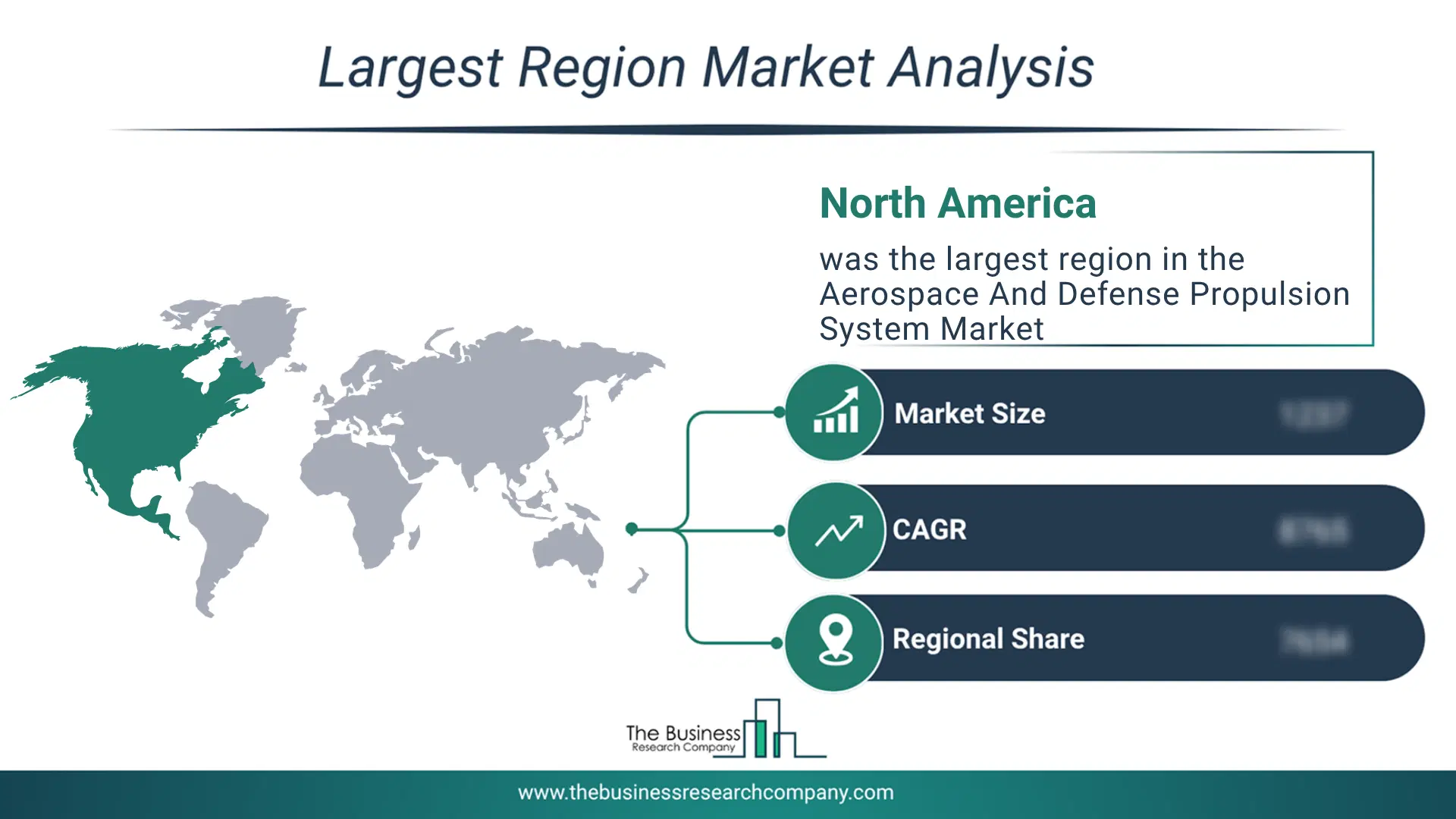
Regional Insights
North America was the largest region in the aerospace and defense propulsion system market in 2025. The regions covered in this market report are Asia-Pacific, South East Asia, Western Europe, Eastern Europe, North America, South America, Middle East, Africa. The countries covered in this market report are Australia, Brazil, China, France, Germany, India, Indonesia, Japan, Taiwan, Russia, South Korea, UK, USA, Canada, Italy, SpainWhat Defines the Aerospace And Defense Propulsion System Market?
The aerospace and defense propulsion system market consists of sales of turboshaft engines, electric propulsion systems, and turbojet engines. Values in this market are ‘factory gate’ values, that is, the value of goods sold by the manufacturers or creators of the goods, whether to other entities (including downstream manufacturers, wholesalers, distributors, and retailers) or directly to end customers. The value of goods in this market includes related services sold by the creators of the goods.How is Market Value Defined and Measured?
The market value is defined as the revenues that enterprises gain from the sale of goods and/or services within the specified market and geography through sales, grants, or donations in terms of the currency (in USD unless otherwise specified). The revenues for a specified geography are consumption values that are revenues generated by organizations in the specified geography within the market, irrespective of where they are produced. It does not include revenues from resales along the supply chain, either further along the supply chain or as part of other products.
This chart presents market attractiveness based on a quantitative evaluation of growth, competition, strategic alignment, and risk, offering a clear view of opportunity areas for decision-making. This chart is for illustrative purposes; the full report contains the complete analysis.

This chart highlights the Total Addressable Market (TAM) by estimating the maximum revenue opportunity using an assumption-driven approach, supporting strategic planning and opportunity sizing across markets. The chart is illustrative; the full report provides a more comprehensive analysis.
What Key Data and Analysis Are Included in the Aerospace And Defense Propulsion System Market Report 2026?
The aerospace and defense propulsion system market research report is one of a series of new reports from The Business Research Company that provides market statistics, including industry global market size, regional shares, competitors with the market share, detailed market segments, market trends and opportunities, and any further data you may need to thrive in the aerospace and defense propulsion system industry. The market research report delivers a complete perspective of everything you need, with an in-depth analysis of the current and future state of the industry.Aerospace And Defense Propulsion System Market Report Forecast Analysis
| Report Attribute | Details |
|---|---|
| Market Size Value In 2026 | $304.6 billion |
| Revenue Forecast In 2030 | $394.14 billion |
| Growth Rate | CAGR of 6.7% from 2026 to 2030 |
| Base Year For Estimation | 2025 |
| Actual Estimates/Historical Data | 2020-2025 |
| Forecast Period | 2026 - 2030 |
| Market Representation | Revenue in USD Billion and CAGR from 2026 to 2030 |
| Segments Covered | Type, Application, End-Use |
| Regional Scope | Asia-Pacific, Western Europe, Eastern Europe, North America, South America, Middle East, Africa |
| Country Scope | The countries covered in the aerospace and defense propulsion system market report are Australia, Brazil, China, France, Germany, India, Indonesia, Japan, Taiwan, Russia, South Korea, UK, USA, Canada, Italy, Spain |
| Key Companies Profiled | Lockheed Martin Corporation, Airbus SE, General Electric Company, Northrop Grumman Corporation, Honeywell International Inc., Pratt & Whitney, Safran S.A., L3Harris Technologies Inc., IHI Corporation, SpaceX, MTU Aero Engines AG, Moog Inc., Blue Origin LLC, ArianeGroup, ITP Aero, Rocket Lab USA Inc., Ursa Major Technologies Inc., Dawn Aerospace, Astra Space Inc., HyImpulse Technologies GmbH, BluShift Aerospace Inc. |
| Customization Scope | Request for Customization |
| Pricing And Purchase Options | Explore Purchase Options |