
Hydrogen Pressure Vessels Market Report 2026
Global Outlook – By Type (Type I, Type II, Type III, Type IV), By Process Type (Towpreg Process, Wet Winding Process), By Application (Storage, Distribution, Stationary Or Mobile Refueling) – Market Size, Trends, Strategies, and Forecast to 2030
Hydrogen Pressure Vessels Market Overview
• Hydrogen Pressure Vessels market size has reached to $11.26 billion in 2025 • Expected to grow to $18.03 billion in 2030 at a compound annual growth rate (CAGR) of 9.9% • Growth Driver: Rising Adoption Of Hydrogen Fuel Cell Vehicles Drives Growth In The Market Fueled By Increasing Demand For Safe And Efficient Hydrogen Storage • Market Trend: Innovations In Hydrogen Storage For Heavy-Duty Vehicles • Asia-Pacific was the largest region in 2025.What Is Covered Under Hydrogen Pressure Vessels Market?
Hydrogen pressure vessels are defined as specialized containers or tanks designed to store and transport hydrogen gas at high pressures. These vessels are designed for safely handling hydrogen, which is a lightweight, volatile, and highly flammable gas. The main types of hydrogen pressure vessels are Type I, Type II, Type III, and Type IV. Type I hydrogen pressure vessels are made entirely of metal, usually steel or aluminum, and are known for their robust and durable construction. Process types include towpreg process and wet winding process. Applications include storage, distribution, and stationary or mobile refueling.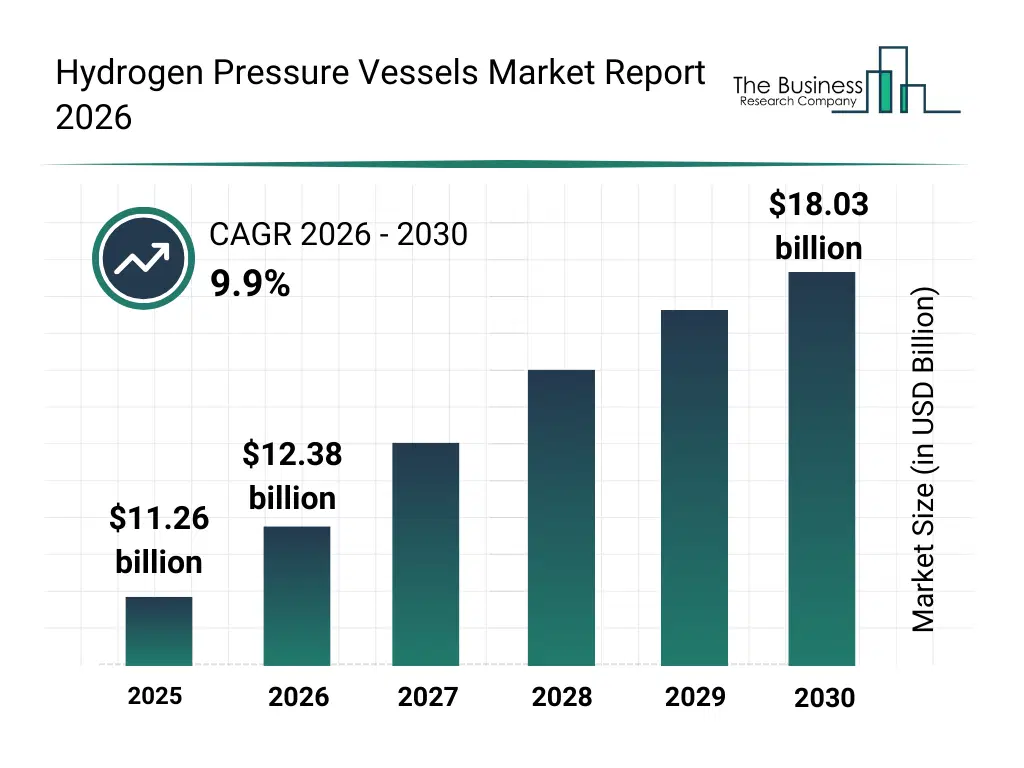
What Is The Hydrogen Pressure Vessels Market Size and Share 2026?
The hydrogen pressure vessels market size has grown strongly in recent years. It will grow from $11.26 billion in 2025 to $12.38 billion in 2026 at a compound annual growth rate (CAGR) of 9.9%. The growth in the historic period can be attributed to hydrogen storage research, industrial gas cylinder usage, steel vessel dominance, early mobility pilots, safety standard development.What Is The Hydrogen Pressure Vessels Market Growth Forecast?
The hydrogen pressure vessels market size is expected to see strong growth in the next few years. It will grow to $18.03 billion in 2030 at a compound annual growth rate (CAGR) of 9.9%. The growth in the forecast period can be attributed to hydrogen mobility expansion, renewable hydrogen production growth, cost reduction in composites, infrastructure investment, stricter safety regulations. Major trends in the forecast period include shift toward composite vessel adoption, demand for lightweight high pressure storage, expansion of refueling infrastructure tanks, focus on safety certification compliance, scaling of mass production.Tariff Impact On Hydrogen Pressure Vessels Market
Tariffs on carbon fiber, resin systems, metal liners, and pressure vessel manufacturing equipment are increasing costs across the hydrogen pressure vessels market. Europe, North America, and Japan are most affected due to reliance on imported advanced composites, while Asia-Pacific manufacturers face export pricing pressure. These tariffs elevate storage system costs and slow refueling infrastructure deployment. Conversely, they are stimulating regional composite manufacturing, alternative material development, and innovation in cost-optimized, high-strength hydrogen pressure vessel designs.
Global Hydrogen Pressure Vessels Market Segmentation
1) By Type: Type I, Type II, Type III, Type IV 2) By Process Type: Towpreg Process, Wet Winding Process 3) By Application: Storage, Distribution, Stationary Or Mobile Refueling Subsegments: 1) By Type I: Steel Cylinders, Seamless Pressure Vessels 2) By Type II: Hoop-Wrapped Steel Vessels, Composite Overwrapped Pressure Vessels 3) By Type III: Fully Wrapped Composite Vessels With Metal Liner, Carbon Fiber Reinforced Vessels 4) By Type IV: Fully Wrapped Composite Vessels With Polymer Liner, High-Pressure Hydrogen Storage TanksWhat Is The Driver Of The Hydrogen Pressure Vessels Market?
The increasing adoption of hydrogen fuel cell vehicles (FCVs) is expected to propel the growth of the hydrogen pressure vessels markets going forward. Hydrogen fuel cell vehicles (FCEVs) are vehicles powered by electricity generated from hydrogen gas through a fuel cell, producing only water as a by-product. The increasing adoption of hydrogen fuel cell vehicles (FCVs) is due to its high-capacity, lightweight, and safe storage solutions for compressed hydrogen, driving advancements in this critical component of hydrogen infrastructure. Hydrogen pressure vessels securely store compressed hydrogen gas at high pressures, ensuring a reliable fuel supply for the fuel cell system, which converts hydrogen into electricity to power the vehicle while enabling extended driving ranges and promoting zero-emission transportation. For instance, in January 2024, according to the U.S. Department of Energy, a US-based government agency, in December 2023, plug-in electric vehicles accounted for 9.8% of all light-duty vehicle sales, up from 7.8% in December 2022. Throughout 2023, plug-in vehicles consistently made up at least 8% of monthly sales, whereas in 2022 their share ranged between 5.5% and 7.8%. Therefore, the increasing adoption of hydrogen fuel cell vehicles (FCVs) is driving the growth of the hydrogen pressure vessels industry.Key Players In The Global Hydrogen Pressure Vessels Market
Major companies operating in the hydrogen pressure vessels market are Worthington Industries, Inc., Luxfer Gas Cylinders Ltd., FIBA Technologies, Inc., NPROXX B.V., Quantum Fuel Systems LLC, ILJIN Hysolus Co., Ltd., BNH Gas Tanks Co., Ltd., Steelhead Composites, Inc., AVANCO Composites, Inc., VAKO GmbH & Co. KG, Hexagon Purus ASA, CIMC Enric Holdings Limited, Mahytec SAS (McPhy Group), Plastic Omnium New Energies SAS (OPmobility SE), Doosan Mobility Innovation Co., Ltd., CP Industries, Inc. (a division of CBI – Chicago Bridge & Iron Company), Sinoma Science & Technology Co., Ltd. (Composite Cylinders Division), Faber Industrie S.p.A., Beijing Tianhai Industry Co., Ltd., Everest Kanto Cylinder Limited, Norris Cylinder Company, Rama Cylinders Private Limited, INOX India Limited, HBank Technologies Inc.
This chart is for illustrative purposes; the full report includes a detailed competitor analysis and comprehensive overview of the top 10 companies in the market.
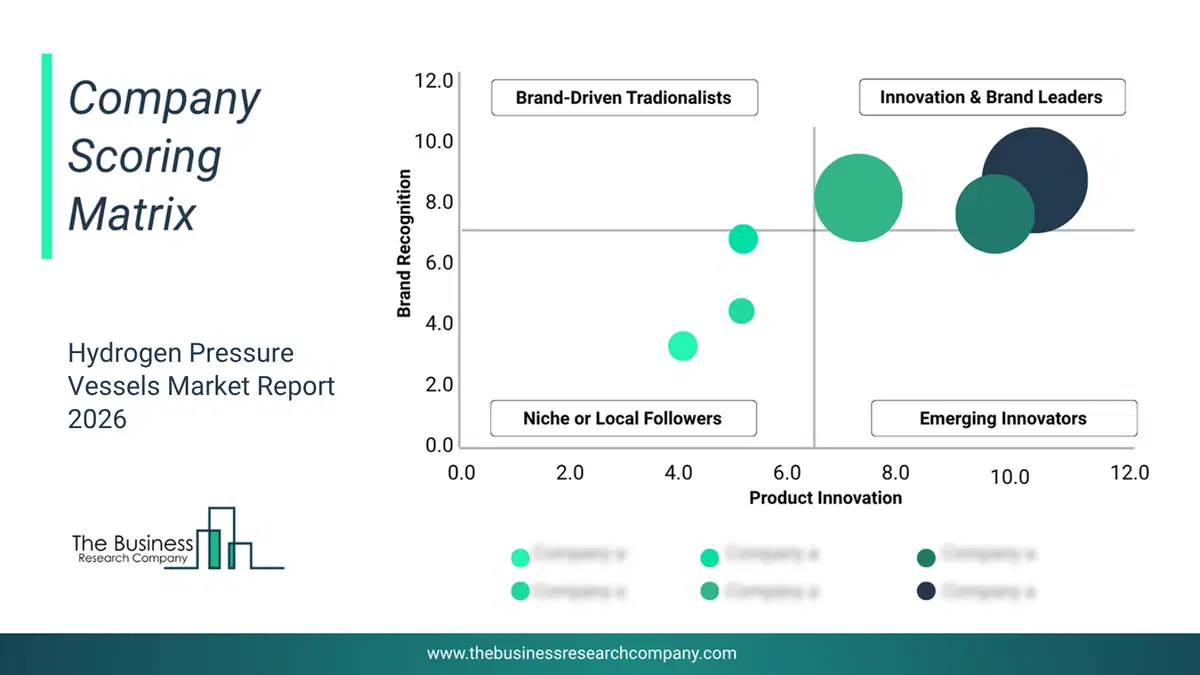
This chart maps companies by product innovation and brand strength, with bubble size indicating relative revenue, helping identify market leaders, challengers, and niche players. This is an illustrative chart; the full report provides a complete and accurate competitive analysis.
Global Hydrogen Pressure Vessels Market Trends and Insights
Major companies operating in the hydrogen pressure vessels market are focusing on developing high-pressure hydrogen storage vessels to enhance storage efficiency. A high-pressure hydrogen storage vessel is a specialized container designed to safely store hydrogen gas at pressures typically exceeding 350 bar (5,000 psi), enabling efficient storage and transportation for various applications, including fuel cell vehicles and industrial uses. For instance, in September 2024, NPROXX, a Netherlands-based high-pressure hydrogen storage solutions company, launched the AH710-70 hydrogen storage solutions. This is an advanced high-pressure hydrogen storage vessel developed for the automotive industry, especially designed for heavy-duty vehicles and long-haul trucks. This is capable of storing 22.2 kg of usable hydrogen at 700 bars, and offers a compact, efficient, and secure solution for hydrogen storage. These vessels consist of a volume of 553 liters, a weight of 338 kg, and optimized for seamless integration into various vehicle designs, that ensures versatility and performance. The AH710-70 is set to be commercially available in Q3 2024, addressing the increasing demand for dependable hydrogen storage solutions in the automotive sector.What Are Latest Mergers And Acquisitions In The Hydrogen Pressure Vessels Market?
In April 2023, Haydale, a UK-based technology company, partnered with Viritech for an undisclosed amount. With this partnership, they aim to develop the world’s most efficient hydrogen storage system using graphene-enhanced carbon fiber for linerless Type V pressure vessels. Viritech is a UK-based technology company focused on developing hydrogen solutions.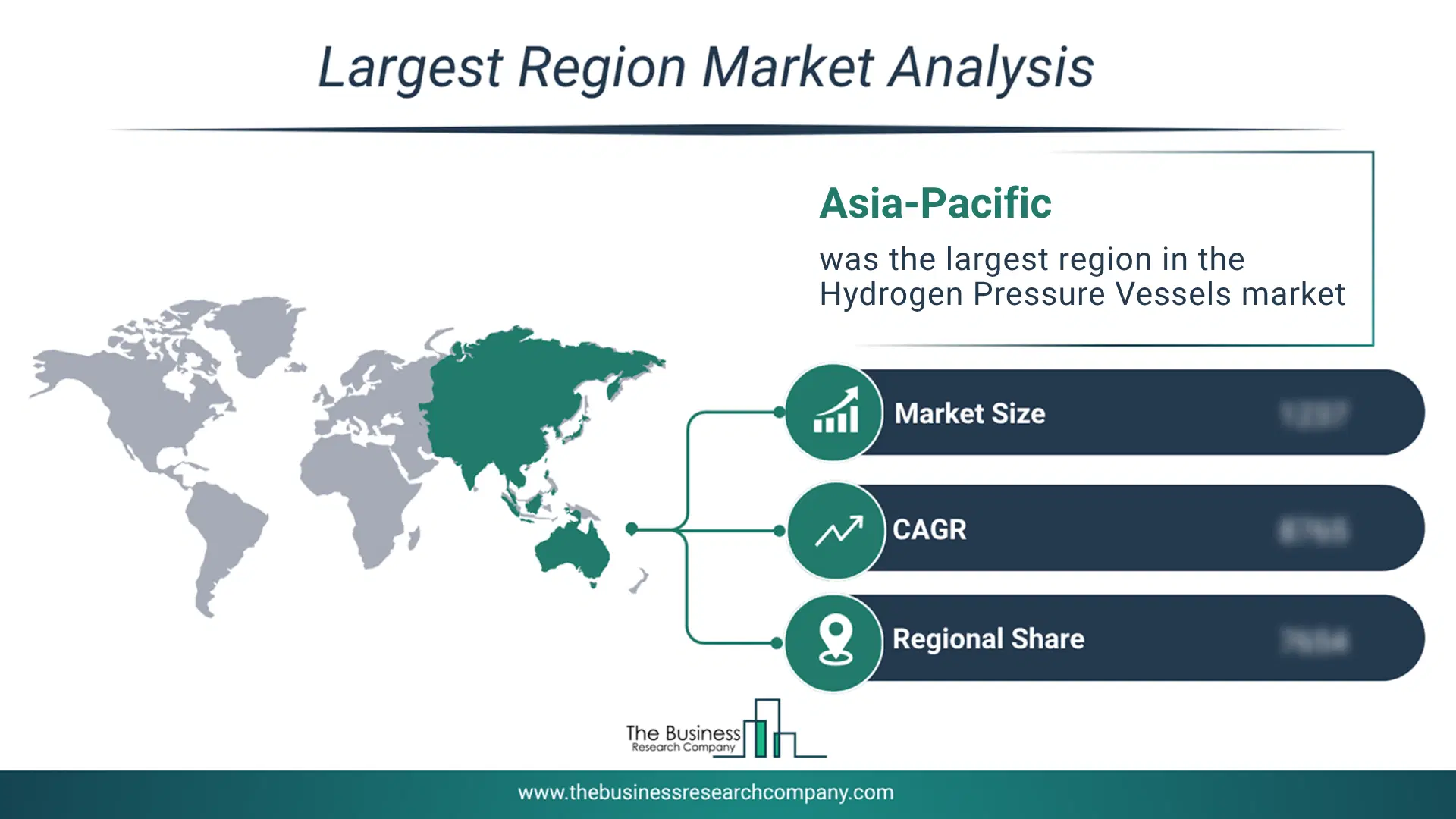
Regional Outlook
Asia-Pacific was the largest region in the hydrogen pressure vessels market in 2025. The regions covered in this market report are Asia-Pacific, South East Asia, Western Europe, Eastern Europe, North America, South America, Middle East, Africa The countries covered in this market report are Australia, Brazil, China, France, Germany, India, Indonesia, Japan, Taiwan, Russia, South Korea, UK, USA, Canada, Italy, Spain.What Defines the Hydrogen Pressure Vessels Market?
The hydrogen pressure vessels market consists of sales of metallic pressure vessels, metal-lined composite pressure vessels, and linerless composite pressure vessels. Values in this market are ‘factory gate’ values, that is, the value of goods sold by the manufacturers or creators of the goods, whether to other entities (including downstream manufacturers, wholesalers, distributors, and retailers) or directly to end customers. The value of goods in this market includes related services sold by the creators of the goodsHow is Market Value Defined and Measured?
The market value is defined as the revenues that enterprises gain from the sale of goods and/or services within the specified market and geography through sales, grants, or donations in terms of the currency (in USD unless otherwise specified). The revenues for a specified geography are consumption values that are revenues generated by organizations in the specified geography within the market, irrespective of where they are produced. It does not include revenues from resales along the supply chain, either further along the supply chain or as part of other products.
This chart presents market attractiveness based on a quantitative evaluation of growth, competition, strategic alignment, and risk, offering a clear view of opportunity areas for decision-making. This chart is for illustrative purposes; the full report contains the complete analysis.

This chart highlights the Total Addressable Market (TAM) by estimating the maximum revenue opportunity using an assumption-driven approach, supporting strategic planning and opportunity sizing across markets. The chart is illustrative; the full report provides a more comprehensive analysis.
What Key Data and Analysis Are Included in the Hydrogen Pressure Vessels Market Report 2026?
The hydrogen pressure vessels market research report is one of a series of new reports from The Business Research Company that provides market statistics, including industry global market size, regional shares, competitors with the market share, detailed market segments, market trends and opportunities, and any further data you may need to thrive in the hydrogen pressure vessels industry. The market research report delivers a complete perspective of everything you need, with an in-depth analysis of the current and future state of the industry.Hydrogen Pressure Vessels Market Report Forecast Analysis
| Report Attribute | Details |
|---|---|
| Market Size Value In 2026 | $12.38 billion |
| Revenue Forecast In 2030 | $18.03 billion |
| Growth Rate | CAGR of 9.9% from 2026 to 2030 |
| Base Year For Estimation | 2025 |
| Actual Estimates/Historical Data | 2020-2025 |
| Forecast Period | 2026 - 2030 |
| Market Representation | Revenue in USD Billion and CAGR from 2026 to 2030 |
| Segments Covered | Type, Process Type, Application |
| Regional Scope | Asia-Pacific, Western Europe, Eastern Europe, North America, South America, Middle East, Africa |
| Key Companies Profiled | Worthington Industries, Inc., Luxfer Gas Cylinders Ltd., FIBA Technologies, Inc., NPROXX B.V., Quantum Fuel Systems LLC, ILJIN Hysolus Co., Ltd., BNH Gas Tanks Co., Ltd., Steelhead Composites, Inc., AVANCO Composites, Inc., VAKO GmbH & Co. KG, Hexagon Purus ASA, CIMC Enric Holdings Limited, Mahytec SAS (McPhy Group), Plastic Omnium New Energies SAS (OPmobility SE), Doosan Mobility Innovation Co., Ltd., CP Industries, Inc. (a division of CBI – Chicago Bridge & Iron Company), Sinoma Science & Technology Co., Ltd. (Composite Cylinders Division), Faber Industrie S.p.A., Beijing Tianhai Industry Co., Ltd., Everest Kanto Cylinder Limited, Norris Cylinder Company, Rama Cylinders Private Limited, INOX India Limited, HBank Technologies Inc. |
| Customization Scope | Request for Customization |
| Pricing And Purchase Options | Explore Purchase Options |