

Hypergolic Propellant Systems Market Report 2026
Global Outlook – By Propellant Type (Monomethylhydrazine (MMH), Unsymmetrical Dimethylhydrazine (UDMH), Nitrogen Tetroxide (N2O,, Other Propellant Type), By Application (Spacecraft, Launch Vehicles, Satellites, Other Applications ), By End-User (Commercial, Military, Government) – Market Size, Trends, Strategies, and Forecast to 2030
Hypergolic Propellant Systems Market Overview
• Hypergolic Propellant Systems market size has reached to $1.56 billion in 2025 • Expected to grow to $2.32 billion in 2030 at a compound annual growth rate (CAGR) of 8.1% • Growth Driver: Increasing Space Exploration Activities Fueling The Growth Of The Market Due To Rising Demand For Reliable And Precise In-Space Propulsion • Market Trend: Advanced Throttleable Engine Enhances In-Space Maneuverability • North America was the largest region and fastest growing region.What Is Covered Under Hypergolic Propellant Systems Market?
Hypergolic propellant systems are rocket propulsion technologies that use a fuel and an oxidizer that ignites spontaneously upon contact, eliminating the need for an external ignition source. This property makes them highly reliable and suitable for applications where quick or repeated engine starts are necessary, such as spacecraft maneuvering thrusters and orbital insertion engines. These systems are commonly used in satellite propulsion and crewed space missions due to their simplicity and ease of restart in space The main types of hypergolic propellant systems are monomethylhydrazine (MMH), unsymmetrical dimethylhydrazine (UDMH), nitrogen tetroxide (N2O4) and others. Monomethylhydrazine (MMH) refers to a highly reactive, volatile, and toxic chemical compound with the chemical formula CH3NHNH2. These are used for various applications, including spacecraft, launch vehicles, satellites and others, serving end users such as commercial, military and government sectors.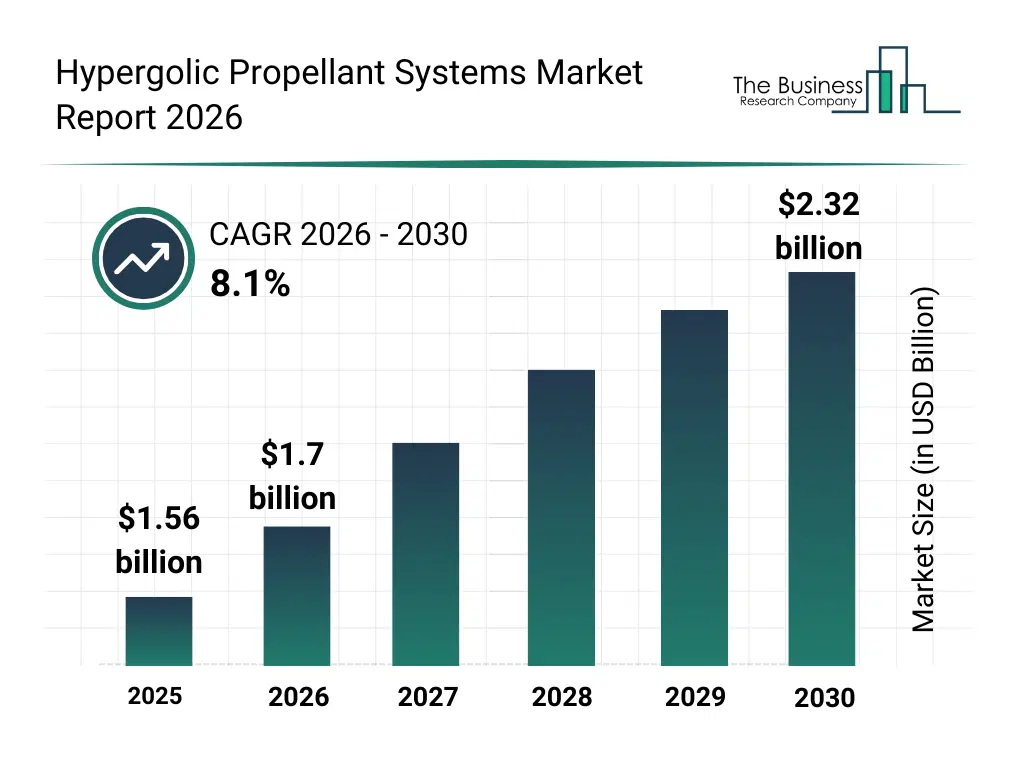
What Is The Hypergolic Propellant Systems Market Size and Share 2026?
The hypergolic propellant systems market size has grown strongly in recent years. It will grow from $1.56 billion in 2025 to $1.7 billion in 2026 at a compound annual growth rate (CAGR) of 9.0%. The growth in the historic period can be attributed to increasing reliance on hypergolic thrusters for spacecraft maneuvering, rising use of hydrazine derivatives, expansion of commercial satellite launches, reliance on imported aerospace chemicals, early adoption of restartable in-orbit engines.What Is The Hypergolic Propellant Systems Market Growth Forecast?
The hypergolic propellant systems market size is expected to see strong growth in the next few years. It will grow to $2.32 billion in 2030 at a compound annual growth rate (CAGR) of 8.1%. The growth in the forecast period can be attributed to increasing development of green hypergolic propellants, rising investment in advanced propulsion modules, growth in autonomous spacecraft maneuvering, expansion of government space programs, increasing demand for high-reliability orbital engines. Major trends in the forecast period include integration of AI-based propellant flow control, expansion of automated hypergolic system manufacturing, growth of digital safety and monitoring platforms, adoption of low-emission hypergolic alternatives, development of autonomous in-orbit maneuvering thrusters.
Global Hypergolic Propellant Systems Market Segmentation
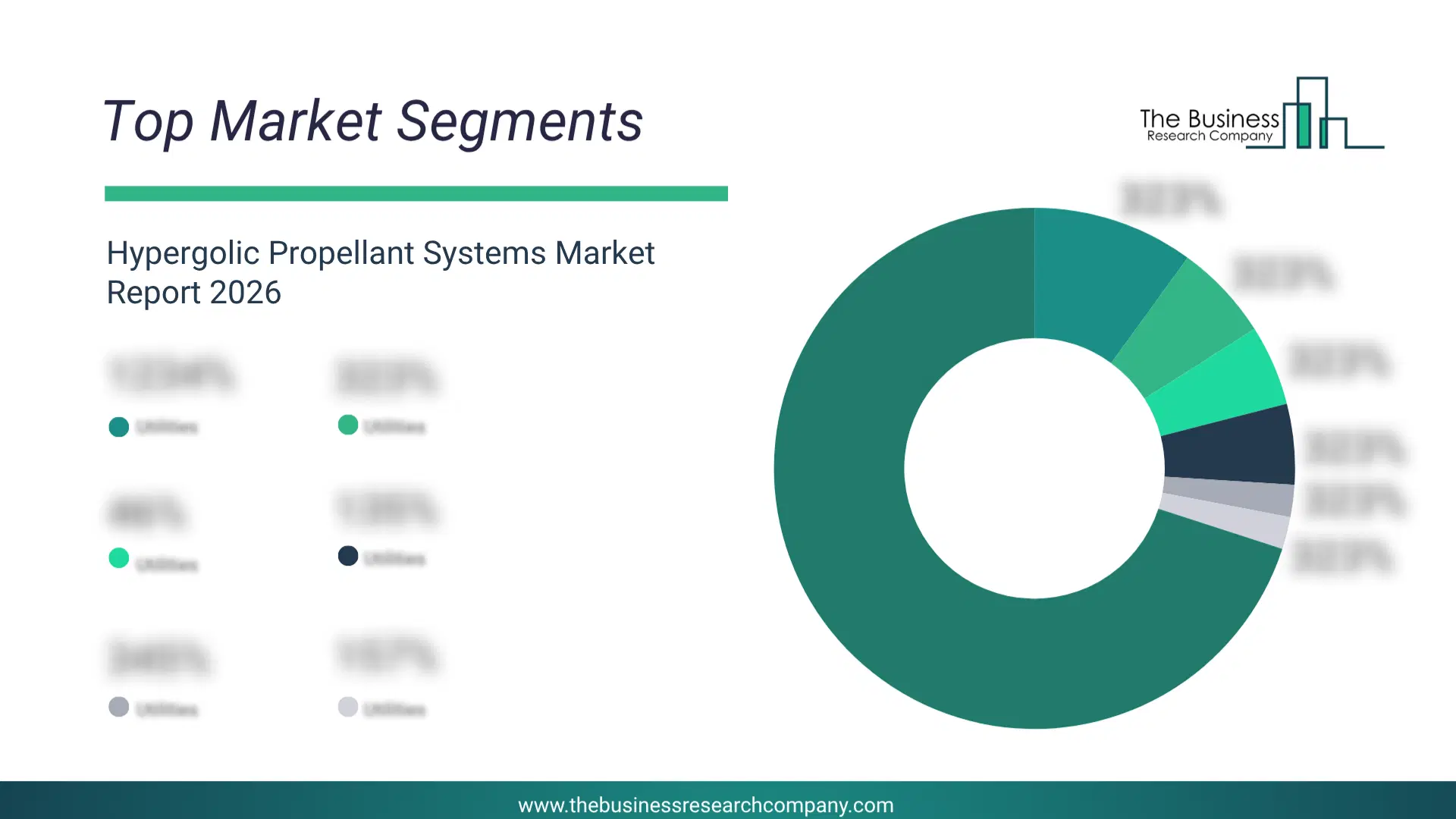
1) By Propellant Type: Monomethylhydrazine (MMH), Unsymmetrical Dimethylhydrazine (UDMH), Nitrogen Tetroxide (N2O4), Other Propellant Type 2) By Application: Spacecraft, Launch Vehicles, Satellites, Other Applications 3) By End-User: Commercial, Military, Government Subsegments: 1) By Monomethylhydrazine (MMH): Aerospace-Grade Monomethylhydrazine (MMH), Commercial-Grade Monomethylhydrazine (MMH), Monomethylhydrazine (MMH) With Inhibitors, High-Purity Monomethylhydrazine (MMH) 2) By Unsymmetrical Dimethylhydrazine (UDMH): Aerospace-Grade Unsymmetrical Dimethylhydrazine (UDMH), Blended Unsymmetrical Dimethylhydrazine (UDMH) Formulations, Stabilized Unsymmetrical Dimethylhydrazine (UDMH), Technical-Grade Unsymmetrical Dimethylhydrazine (UDMH) 3) By Nitrogen Tetroxide (N2O4): Inhibited Red Fuming Nitric Acid (IRFNA), High-Density Nitrogen Tetroxide (N2O4), Mixed Oxides Of Nitrogen (MON), Cryogenic Nitrogen Tetroxide (N2O4) Derivatives 4) By Other Propellant: Hydrazine Derivatives, Green Hypergolic Propellants, Ionic Liquid Propellants, Triethylaluminum-Triethylborane (TEA-TEB) SystemsWhat Is The Driver Of The Hypergolic Propellant Systems Market?
The increasing space exploration activities is expected to propel the growth of the hypergolic propellant systems market going forward. Space exploration activities refer to the pursuit of scientific discovery, technological advancement, and commercial opportunities beyond Earth through missions, research, and space-based operations. The space exploration activities are increasing due to growing demand for advanced communication and Earth observation satellites, as they enable global connectivity, environmental monitoring, and enhanced security. Hypergolic propellant systems enhance space exploration activities by providing reliable and instant ignition, making them ideal for critical maneuvers in space. They support precise thrust control and long-term storability, improving mission safety and operational flexibility. For instance, in September 2023, according to Novaspace, a France-based space consulting firm, government spending on space exploration totaled $27 billion in 2024 and is projected to reach nearly $31 billion by 2034. Therefore, the increasing space exploration activities is driving the growth of the hypergolic propellant systems industry.Key Players In The Global Hypergolic Propellant Systems Market
Major companies operating in the hypergolic propellant systems market are IHI Corporation, RTX Corporation, Airbus SE, The Boeing Company, Lockheed Martin Corporation, Northrop Grumman Corporation, Safran Aircraft Engines S.A.S., L3Harris Technologies Inc., Space Exploration Technologies Corp., Blue Origin LLC, ArianeGroup SAS, Thales Alenia Space S.A.S., The Aerospace Corporation, OHB System AG, Sierra Space Corporation, Rocket Lab USA Inc., Sitael S.p.A., Agile Space Industries Inc., InSpacePropulsion Technologies GmbH, Bradford Space Inc.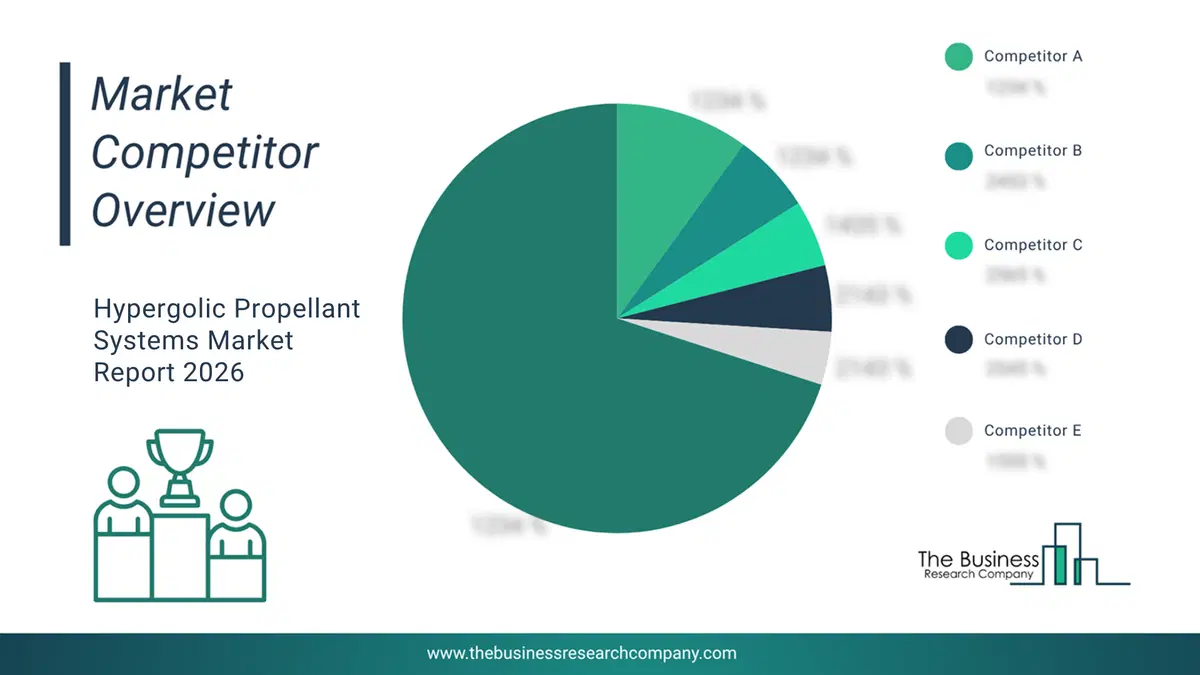
This chart is for illustrative purposes; the full report includes a detailed competitor analysis and comprehensive overview of the top 10 companies in the market.
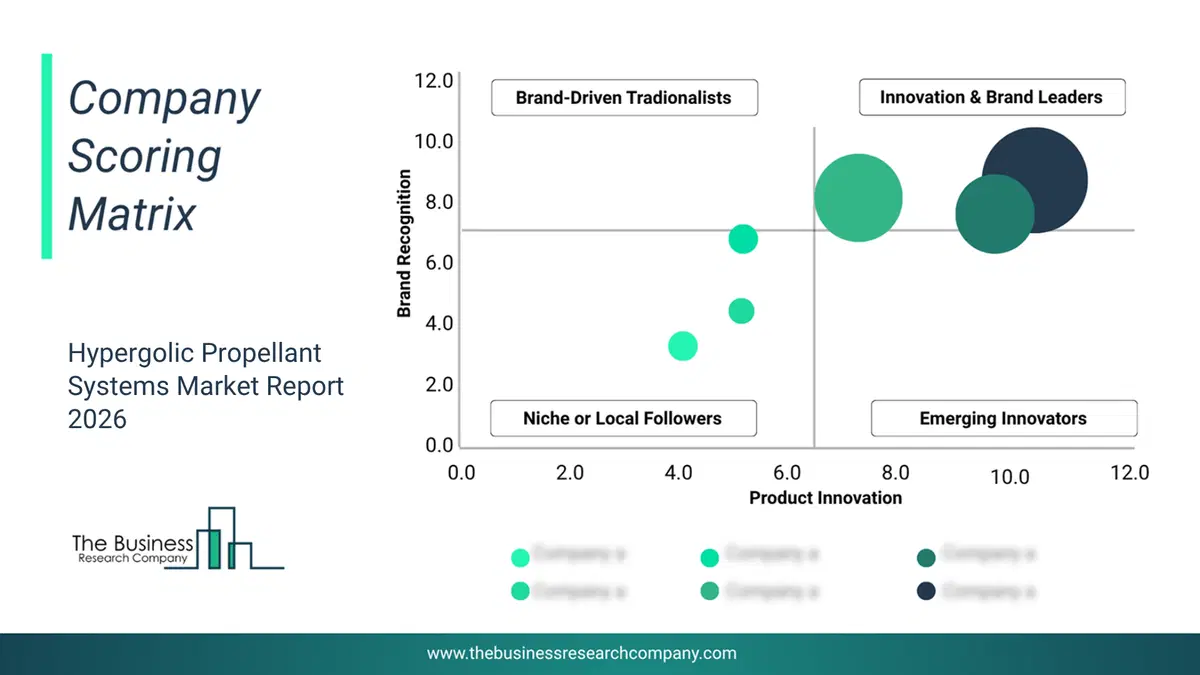
This chart maps companies by product innovation and brand strength, with bubble size indicating relative revenue, helping identify market leaders, challengers, and niche players. This is an illustrative chart; the full report provides a complete and accurate competitive analysis.
Global Hypergolic Propellant Systems Market Trends and Insights
Major companies operating in the hypergolic propellant systems market are focusing on developing advanced propulsion technologies, such as throttleable rocket engines, to enhance mission flexibility, improve performance, and enable precise control in space operations. Throttleable rocket engines refer to propulsion systems that can adjust their thrust levels smoothly and efficiently during flight, allowing for optimized fuel consumption and greater maneuverability. For instance, in November 2023, Sierra Space Corporation, a US-based aerospace company, tested its new 5,500 pound-force (lbf) hypergolic rocket engine. This engine is capable of continuous throttling, providing exceptional control for in-space propulsion applications. The advanced hypergolic system ensures reliable ignition and stable performance across varying thrust levels, making it ideal for orbital adjustments, docking maneuvers, and deep-space missions. The engine's design also emphasizes reusability and operational efficiency, aligning with the growing demand for sustainable and adaptable space propulsion solutions.What Are Latest Mergers And Acquisitions In The Hypergolic Propellant Systems Market?
In July 2023, L3Harris Technologies Inc., a US-based aerospace and defense technology company, acquired Aerojet Rocketdyne Holdings Inc. for $4.7 billion. With this acquisition, L3Harris aims to enhance its propulsion capabilities by integrating Aerojet Rocketdyne’s expertise in rocket engines and energetics, strengthening its position in missile defense, hypersonic, and space propulsion. Aerojet Rocketdyne Holdings Inc. is a US-based aerospace and defense company focused on developing and producing hypergolic propellant systems.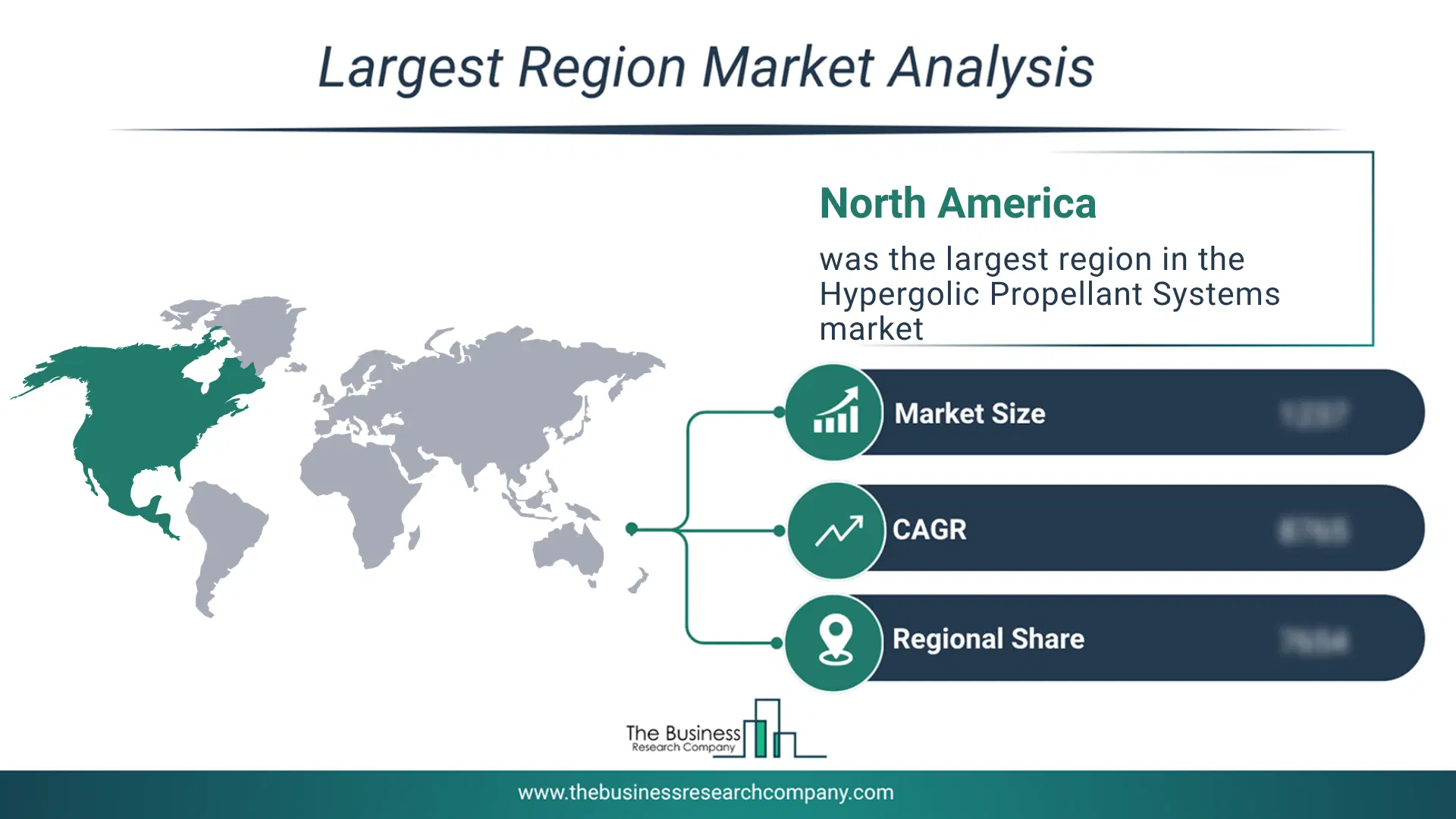
Regional Insights
North America was the largest region in the hypergolic propellant systems market in 2025. The regions covered in this market report are Asia-Pacific, South East Asia, Western Europe, Eastern Europe, North America, South America, Middle East, Africa. The countries covered in this market report are Australia, Brazil, China, France, Germany, India, Indonesia, Japan, Taiwan, Russia, South Korea, UK, USA, Canada, Italy, Spain.What Defines the Hypergolic Propellant Systems Market?
The hypergolic propellant systems market consists of sales of hypergolic thrusters, propellant storage tanks, fuel and oxidizer injectors, feed and control valves, plumbing assemblies, ignition systems, and complete propulsion modules designed for spacecraft and missile applications. Values in this market are ‘factory gate’ values, that is, the value of goods sold by the manufacturers or creators of the goods, whether to other entities (including downstream manufacturers, wholesalers, distributors, and retailers) or directly to end customers. The value of goods in this market includes related services sold by the creators of the goods.How is Market Value Defined and Measured?
The market value is defined as the revenues that enterprises gain from the sale of goods and/or services within the specified market and geography through sales, grants, or donations in terms of the currency (in USD unless otherwise specified). The revenues for a specified geography are consumption values that are revenues generated by organizations in the specified geography within the market, irrespective of where they are produced. It does not include revenues from resales along the supply chain, either further along the supply chain or as part of other products.
This chart presents market attractiveness based on a quantitative evaluation of growth, competition, strategic alignment, and risk, offering a clear view of opportunity areas for decision-making. This chart is for illustrative purposes; the full report contains the complete analysis.

This chart highlights the Total Addressable Market (TAM) by estimating the maximum revenue opportunity using an assumption-driven approach, supporting strategic planning and opportunity sizing across markets. The chart is illustrative; the full report provides a more comprehensive analysis.
What Key Data and Analysis Are Included in theHypergolic Propellant Systems Market Report 2026?
The hypergolic propellant systems market research report is one of a series of new reports from The Business Research Company that provides market statistics, including industry global market size, regional shares, competitors with the market share, detailed market segments, market trends and opportunities, and any further data you may need to thrive in the hypergolic propellant systems industry. The market research report delivers a complete perspective of everything you need, with an in-depth analysis of the current and future state of the industry.Hypergolic Propellant Systems Market Report Forecast Analysis
| Report Attribute | Details |
|---|---|
| Market Size Value In 2026 | $1.7 billion |
| Revenue Forecast In 2030 | $2.32 billion |
| Growth Rate | CAGR of 9.0% from 2026 to 2030 |
| Base Year For Estimation | 2025 |
| Actual Estimates/Historical Data | 2020-2025 |
| Forecast Period | 2026 - 2030 |
| Market Representation | Revenue in USD Billion and CAGR from 2026 to 2030 |
| Segments Covered | Propellant Type, Application, End-User |
| Regional Scope | Asia-Pacific, Western Europe, Eastern Europe, North America, South America, Middle East, Africa |
| Country Scope | The countries covered in this market report are Australia, Brazil, China, France, Germany, India, Indonesia, Japan, Taiwan, Russia, South Korea, UK, USA, Canada, Italy, Spain |
| Key Companies Profiled | IHI Corporation, RTX Corporation, Airbus SE, The Boeing Company, Lockheed Martin Corporation, Northrop Grumman Corporation, Safran Aircraft Engines S.A.S., L3Harris Technologies Inc., Space Exploration Technologies Corp., Blue Origin LLC, ArianeGroup SAS, Thales Alenia Space S.A.S., The Aerospace Corporation, OHB System AG, Sierra Space Corporation, Rocket Lab USA Inc., Sitael S.p.A., Agile Space Industries Inc., InSpacePropulsion Technologies GmbH, Bradford Space Inc. |
| Customization Scope | Request for Customization |
| Pricing And Purchase Options | Explore Purchase Options |