
Space Fuel Production Market Report 2026
Global Outlook – By Fuel Type (Hydrogen, Methane, Nuclear, Solar, Other Fuel Types), By Technology (In-Situ Resource Utilization, Chemical Propulsion, Electric Propulsion, Other Technologies), By Application (Spacecraft Propulsion, Satellite Power Systems, Space Stations, Other Applications), By End-User (Government And Defense, Commercial, Other End-Users) – Market Size, Trends, Strategies, and Forecast to 2030
Space Fuel Production Market Overview
• Space Fuel Production market size has reached to $1.55 billion in 2025 • Expected to grow to $2.54 billion in 2030 at a compound annual growth rate (CAGR) of 10.2% • Growth Driver: Increasing Investments In Space Activities Fueling The Growth Of The Market Due To Rising Demand For Propulsion And Long-Duration Missions • Market Trend: Adoption Of In-Orbit Refuelling Technologies To Extend Satellite Lifetimes • North America was the largest region in 2025.What Is Covered Under Space Fuel Production Market?
Space fuel production refers to the process of creating or extracting propellants (such as hydrogen, oxygen, or methane) in space from extraterrestrial sources such as the Moon, Mars, or asteroids for use in spacecraft propulsion, orbital operations, or refueling missions. The main fuel types in space fuel production are hydrogen, methane, nuclear, solar, and others. Hydrogen, whether in liquid or gaseous form, is used to power spacecraft. It leverages a range of technologies, including in-situ resource utilization, chemical propulsion, electric propulsion, and others, to support diverse applications such as spacecraft propulsion, satellite power systems, and space stations, and it is utilized across various end-users, including government and defense agencies, commercial entities, and others.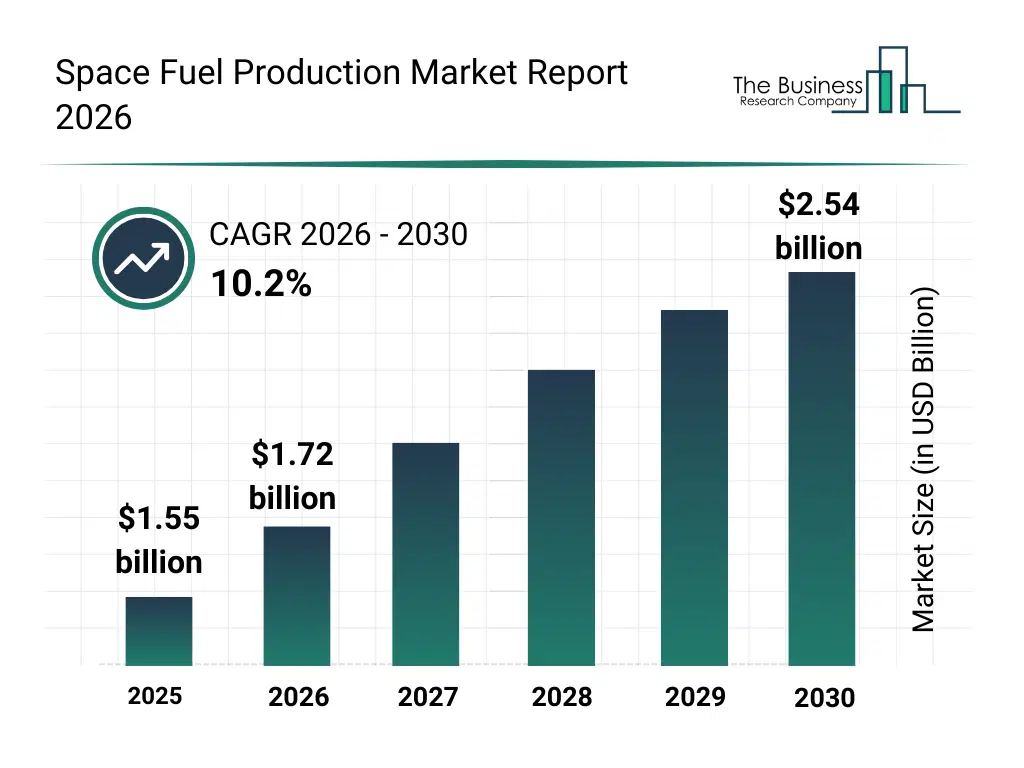
What Is The Space Fuel Production Market Size and Share 2026?
The space fuel production market size has grown rapidly in recent years. It will grow from $1.55 billion in 2025 to $1.72 billion in 2026 at a compound annual growth rate (CAGR) of 11.0%. The growth in the historic period can be attributed to early research into in-situ resource utilization for producing propellants from lunar and martian materials, development of cryogenic fuel storage and management technologies for long-duration missions, initial testing of on-orbit refueling concepts using robotic interfaces, growing use of electric propulsion systems driving demand for specialized ionic liquids, expansion of commercial satellite operations increasing interest in fuel depot concepts.What Is The Space Fuel Production Market Growth Forecast?
The space fuel production market size is expected to see rapid growth in the next few years. It will grow to $2.54 billion in 2030 at a compound annual growth rate (CAGR) of 10.2%. The growth in the forecast period can be attributed to advancement of large-scale lunar and asteroid mining initiatives enabling extraterrestrial fuel extraction, rising deployment of space tugs requiring continuous access to propellant supplies, increasing commercialization of on-orbit refueling services for satellites and deep space missions, development of next-generation cryogenic storage systems with extended thermal stability, growing investment in liquid hydrogen and methane production systems for sustainable off-earth propulsion. Major trends in the forecast period include in-situ resource utilization expansion, cryogenic fuel storage advancements, space tug and fuel depot operations growth, development of electric propulsion fuels, integration of ionic liquid and hybrid rocket fuels.
Global Space Fuel Production Market Segmentation
1) By Fuel Type: Hydrogen, Methane, Nuclear, Solar, Other Fuel Types 2) By Technology: In-Situ Resource Utilization, Chemical Propulsion, Electric Propulsion, Other Technologies 3) By Application: Spacecraft Propulsion, Satellite Power Systems, Space Stations, Other Applications 4) By End-User: Government And Defense, Commercial, Other End-Users Subsegments: 1) By Hydrogen: Liquid Hydrogen, Compressed Hydrogen Gas, Metal Hydride Storage, Cryo-Compressed Hydrogen 2) By Methane: Liquid Methane, Compressed Methane Gas, Methane-Hydrogen Mix, Renewable Methane 3) By Nuclear: Fission-based Nuclear Fuel, Fusion-based Nuclear Fuel, Radioisotope Thermoelectric Generators (RTGs), Nuclear Thermal Propulsion (NTP) 4) By Solar: Photovoltaic Solar Fuel, Solar Thermal Fuel, Solar Hydrogen Production, Solar Biomass Conversion 5) By Other Fuel Types: Ionic Liquid Fuels, Solid Rocket Fuel, Electrochemical Propellants, Hybrid Rocket FuelsWhat Is Driver Of The Space Fuel Production Market?
The increasing number of satellite launches is expected to propel the growth of the space fuel production market going forward. Satellite-based services involve using satellites to deliver functions such as communication, location tracking, weather updates, and remote sensing. Satellite launches are rising due to the growing demand for global connectivity and data access in remote areas. Satellite launches drive demand for space fuel production by requiring efficient and sustainable propellants for propulsion, orbital maneuvers, and extended missions. For instance, in January 2025, Space Foundation, a US-based nonprofit organization, in 2024, 259 launches took place at an average rate of one every 34 hours five hours faster than in 2023. Therefore, the increasing number of satellite launches is driving the growth of the space fuel production industry.Key Players In The Global Space Fuel Production Market
Major companies operating in the space fuel production market are The Boeing Company, Lockheed Martin, Northrop Grumman, SpaceX, Blue Origin, Aerojet Rocketdyne, Sierra Nevada Corporation, United Launch Alliance, Relativity Space, Firefly Aerospace, Firehawk Aerospace, Vaya Space, Astrobotic, Orbit Fab, HyImpulse Technologies, HyPrSpace, bluShift Aerospace, Viridian Space, Momentus, Virgin Galactic, Stoke Space, Impulse Space, Gilmour Space Technologies, Rocket Lab, ISRU Technologies Inc.
This chart is for illustrative purposes; the full report includes a detailed competitor analysis and comprehensive overview of the top 10 companies in the market.
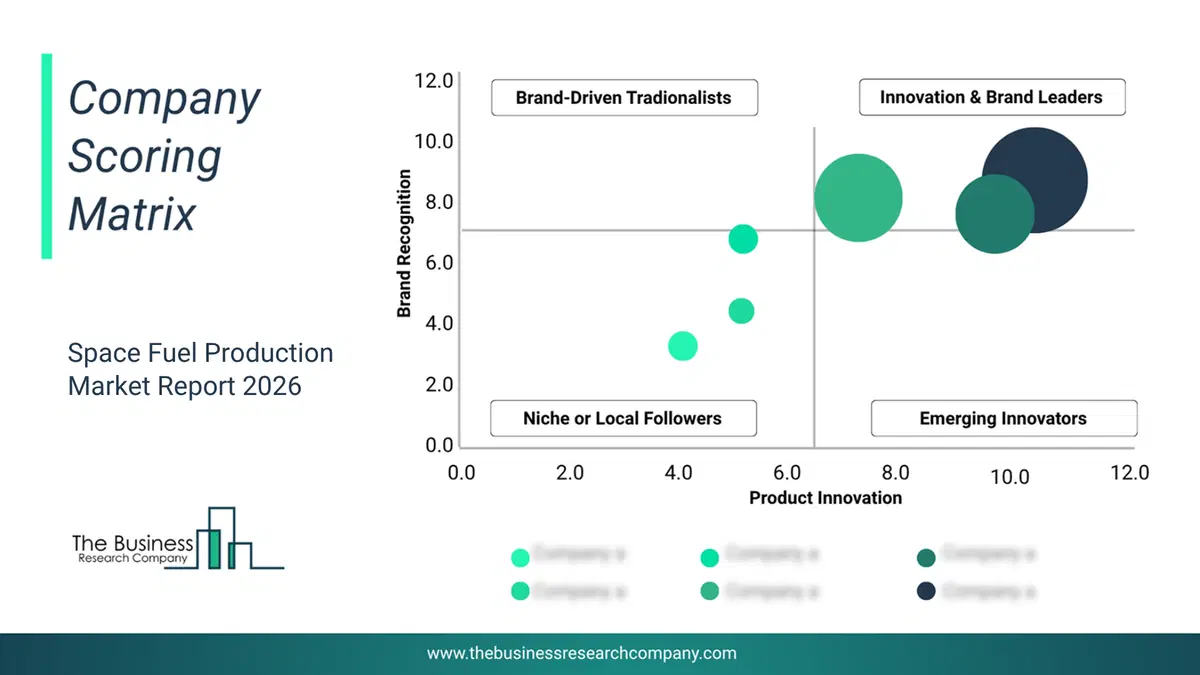
This chart maps companies by product innovation and brand strength, with bubble size indicating relative revenue, helping identify market leaders, challengers, and niche players. This is an illustrative chart; the full report provides a complete and accurate competitive analysis.
Global Space Fuel Production Market Trends and Insights
Major companies operating in the space fuel production market are focusing on developing innovative solutions such as in-orbit refuelling interfaces and propellant depots to support the growing demand for extending satellite lifetimes, enabling reusable spacecraft operations, and reducing launch mass. An in-orbit refuelling interface allows satellites to receive propellant while in space unlike traditional spacecraft that rely solely on pre-loaded fuel at launch thereby enhancing mission flexibility and longevity. For instance, in July 2025, Orbit Fab, Inc., a US-based space services company, launched the RAFTI (Rapidly Attachable Fluid Transfer Interface) Refuelling Port and Fuel Delivery Service for satellites and space vehicles. The RAFTI system enables standardized in-orbit propellant transfer through a compact docking mechanism compatible with multiple fuel types such as hydrazine and xenon. It integrates a lightweight interface for both ground and orbital refuelling, modular depot infrastructure, and mission-planning software to optimize refuelling schedules. This innovation provides greater operational flexibility, extended satellite life, and reduced launch weight compared to traditional single-fuel-load missions.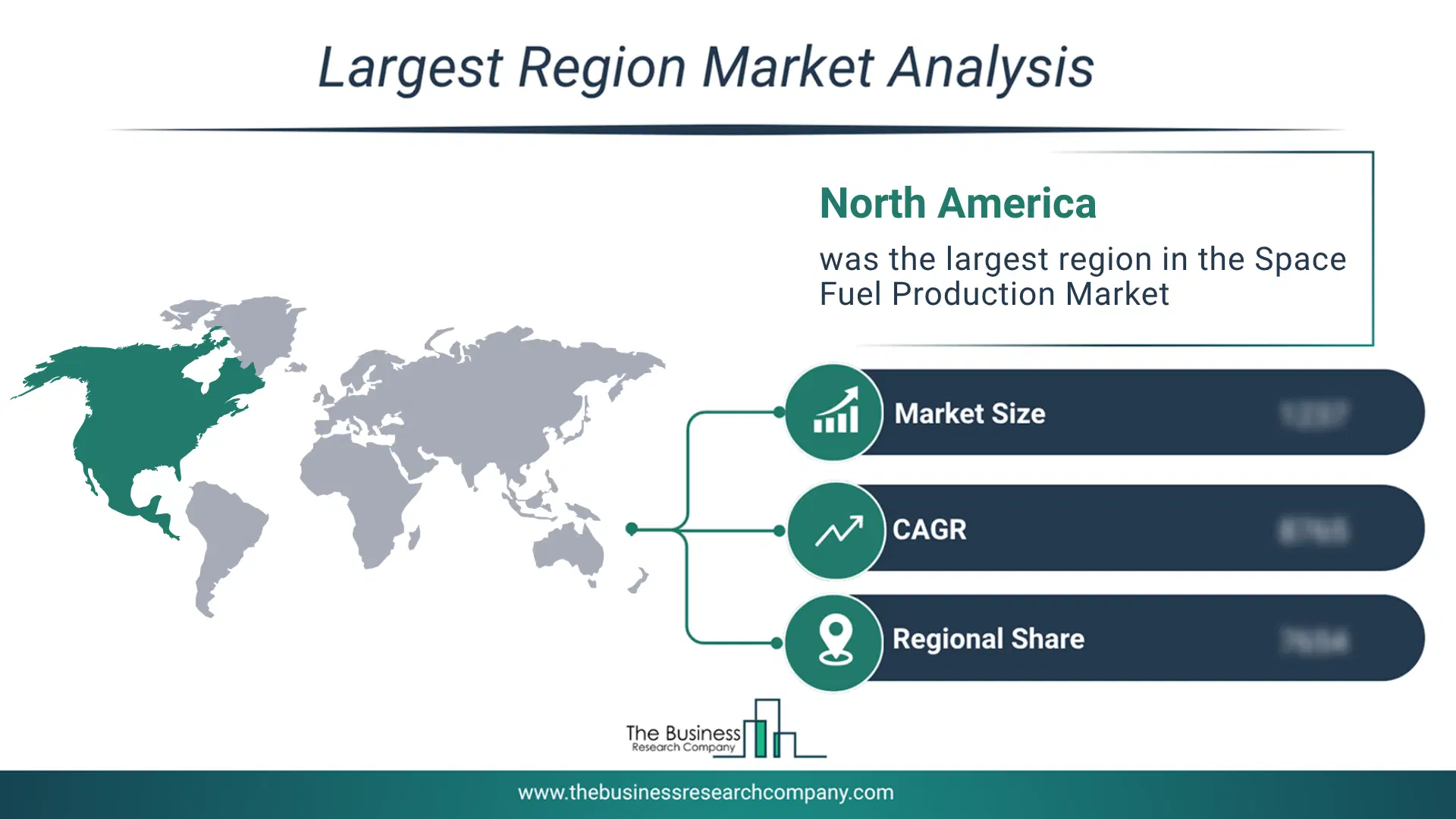
Regional Insights
North America was the largest region in the space fuel production market in 2025. The regions covered in this market report are Asia-Pacific, South East Asia, Western Europe, Eastern Europe, North America, South America, Middle East, Africa. The countries covered in this market report are Australia, Brazil, China, France, Germany, India, Indonesia, Japan, Taiwan, Russia, South Korea, UK, USA, Canada, Italy, SpainWhat Defines the Space Fuel Production Market?
The space fuel production market consists of revenues earned by entities by providing services such as on-orbit refueling services, cryogenic fuel storage and management, and space tug and fuel depot operations. The market value includes the value of related goods sold by the service provider or included within the service offering. The space fuel production market also includes sales of ionic liquids and electric propulsion fuels, solid propellants, and liquid hydrogen. Values in this market are ‘factory gate’ values, that is the value of goods sold by the manufacturers or creators of the goods, whether to other entities (including downstream manufacturers, wholesalers, distributors and retailers) or directly to end customers. The value of goods in this market includes related services sold by the creators of the goods.How is Market Value Defined and Measured?
The market value is defined as the revenues that enterprises gain from the sale of goods and/or services within the specified market and geography through sales, grants, or donations in terms of the currency (in USD unless otherwise specified). The revenues for a specified geography are consumption values that are revenues generated by organizations in the specified geography within the market, irrespective of where they are produced. It does not include revenues from resales along the supply chain, either further along the supply chain or as part of other products.
This chart presents market attractiveness based on a quantitative evaluation of growth, competition, strategic alignment, and risk, offering a clear view of opportunity areas for decision-making. This chart is for illustrative purposes; the full report contains the complete analysis.

This chart highlights the Total Addressable Market (TAM) by estimating the maximum revenue opportunity using an assumption-driven approach, supporting strategic planning and opportunity sizing across markets. The chart is illustrative; the full report provides a more comprehensive analysis.
What Key Data and Analysis Are Included in the Space Fuel Production Market Report 2026?
The space fuel production market research report is one of a series of new reports from The Business Research Company that provides market statistics, including industry global market size, regional shares, competitors with the market share, detailed market segments, market trends and opportunities, and any further data you may need to thrive in the space fuel production industry. The market research report delivers a complete perspective of everything you need, with an in-depth analysis of the current and future state of the industry.Space Fuel Production Market Report Forecast Analysis
| Report Attribute | Details |
|---|---|
| Market Size Value In 2026 | $1.72 billion |
| Revenue Forecast In 2030 | $2.54 billion |
| Growth Rate | CAGR of 10.2% from 2026 to 2030 |
| Base Year For Estimation | 2025 |
| Actual Estimates/Historical Data | 2020-2025 |
| Forecast Period | 2026 - 2030 |
| Market Representation | Revenue in USD Billion and CAGR from 2026 to 2030 |
| Segments Covered | Fuel Type, Technology, Application, End-User |
| Regional Scope | Asia-Pacific, Western Europe, Eastern Europe, North America, South America, Middle East, Africa |
| Country Scope | The countries covered in the space fuel production market report are Australia, Brazil, China, France, Germany, India, Indonesia, Japan, Taiwan, Russia, South Korea, UK, USA, Canada, Italy, Spain |
| Key Companies Profiled | The Boeing Company, Lockheed Martin, Northrop Grumman, SpaceX, Blue Origin, Aerojet Rocketdyne, Sierra Nevada Corporation, United Launch Alliance, Relativity Space, Firefly Aerospace, Firehawk Aerospace, Vaya Space, Astrobotic, Orbit Fab, HyImpulse Technologies, HyPrSpace, bluShift Aerospace, Viridian Space, Momentus, Virgin Galactic, Stoke Space, Impulse Space, Gilmour Space Technologies, Rocket Lab, ISRU Technologies Inc. |
| Customization Scope | Request for Customization |
| Pricing And Purchase Options | Explore Purchase Options |