
Brine Concentration Technology (BCT) Market Report 2026
Global Outlook – By Technology (High Energy Reverse Osmosis, Mechanical Vapor Compression, Closed Circuit Desalination, Vertical Tube Falling Film, Other Technologies), By Type (Calcium Chloride, Sodium Chloride, Zinc Calcium Bromide, Cesium Formate, Potassium Chloride, Other Types), By End User (Coal To Chemicals, Food And Beverage, Mining, Oil And Gas, Pulp And Paper, Steel, Power, Textile, Refining And Petrochemicals, Other End Users) – Market Size, Trends, Strategies, and Forecast to 2030
Brine Concentration Technology (BCT) Market Overview
• Brine Concentration Technology (BCT) market size has reached to $15.29 billion in 2025 • Expected to grow to $20.4 billion in 2030 at a compound annual growth rate (CAGR) of 6.1% • Growth Driver: Climate Change Impact And The Surge In The Brine Concentration Technology (BCT) Market • Market Trend: Strategic Partnerships Drive Innovation In Environmentally Friendly Brine Concentration Technology • Asia-Pacific was the largest region in 2025.What Is Covered Under Brine Concentration Technology (BCT) Market?
Brine concentration technology refers to a process that purifies brine by removing hazardous salts from the water. The purpose of brine concentration technology is to create a sustainable method of extracting compounds from brine through the use of thermal-based brine crystallizers, reverse osmosis, and electrodialysis. The main technologies involved in brine concentration technology (BCT) are high-energy reverse osmosis, mechanical vapor compression, closed circuit desalination, vertical tube falling film, and others. High-energy reverse osmosis refers to a technique that pushes water through a semi-permeable membrane at a pressure greater than 100 bar to remove the vast majority of pollutants from it. Utilizing high-pressure reverse osmosis (HPRO), hypersaline brines are effectively desalinated. Calcium chloride, sodium chloride, zinc calcium bromide, cesium formate, potassium chloride, and other types are involved in brine concentration technology that is used by coal to chemicals, food and beverage, mining, oil and gas, pulp and paper, steel, power, textile, refining and petrochemicals, and other end users.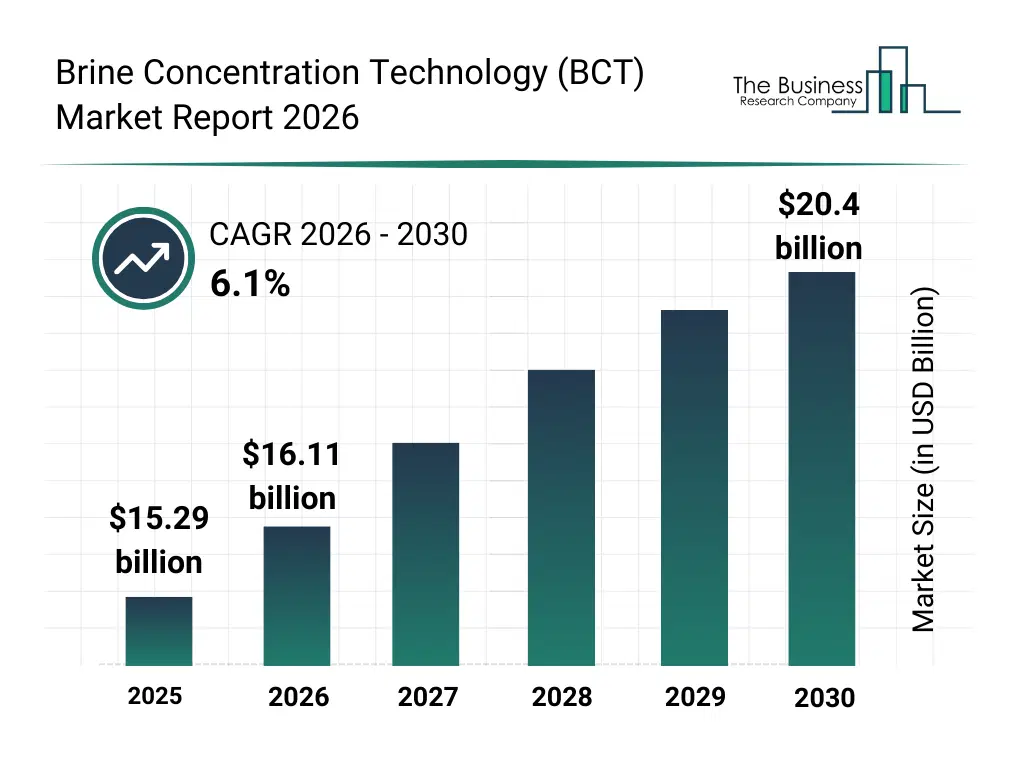
What Is The Brine Concentration Technology (BCT) Market Size and Share 2026?
The brine concentration technology (bct) market size has grown strongly in recent years. It will grow from $15.29 billion in 2025 to $16.11 billion in 2026 at a compound annual growth rate (CAGR) of 5.4%. The growth in the historic period can be attributed to stricter environmental discharge regulations, growth of industrial wastewater generation, expansion of desalination plants, adoption of thermal evaporation technologies, increasing focus on water conservation.What Is The Brine Concentration Technology (BCT) Market Growth Forecast?
The brine concentration technology (bct) market size is expected to see strong growth in the next few years. It will grow to $20.4 billion in 2030 at a compound annual growth rate (CAGR) of 6.1%. The growth in the forecast period can be attributed to increasing investments in sustainable water treatment solutions, rising demand from mining and oil and gas sectors, expansion of industrial desalination projects, growing adoption of energy-efficient systems, increasing focus on circular water economy. Major trends in the forecast period include increasing adoption of zero liquid discharge systems, rising integration of advanced membrane technologies, growing demand for resource recovery solutions, expansion of thermal brine concentration processes, enhanced focus on water reuse.Tariff Impact On Brine Concentration Technology (BCT) Market
Tariffs are impacting the brine concentration technology market by increasing costs of imported membranes, evaporators, compressors, heat exchangers, and control systems used in advanced concentration processes. Industrial users in North America and Europe are most affected due to reliance on imported high-end treatment equipment, while Asia-Pacific faces cost pressure on system manufacturing and exports. These tariffs are raising project implementation costs and extending deployment timelines. However, they are also promoting local equipment manufacturing, regional engineering services, and innovation in energy-efficient and modular brine concentration systems.
Global Brine Concentration Technology (BCT) Market Segmentation
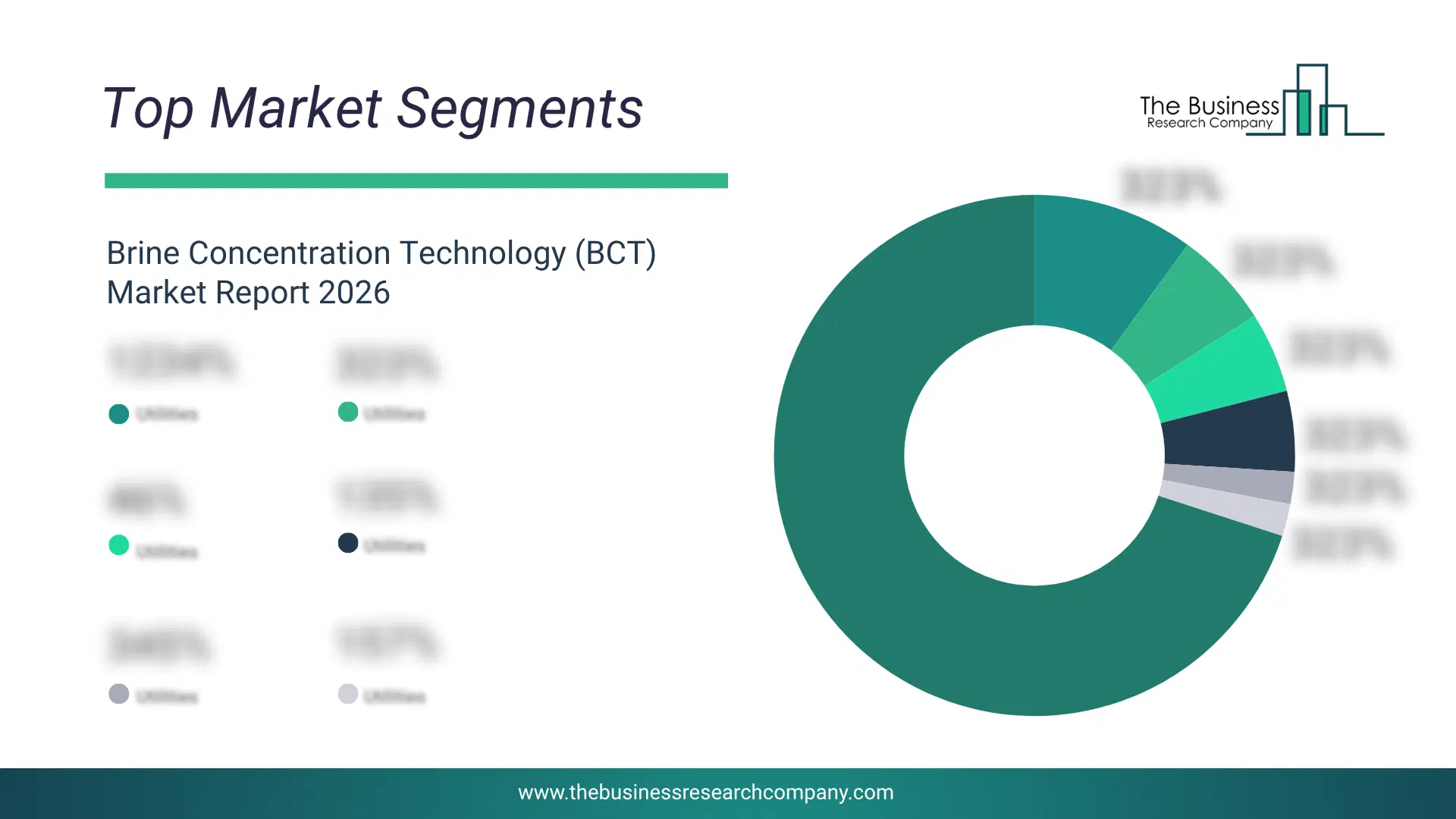
1) By Technology: High Energy Reverse Osmosis, Mechanical Vapor Compression, Closed Circuit Desalination, Vertical Tube Falling Film, Other Technologies 2) By Type: Calcium Chloride, Sodium Chloride, Zinc Calcium Bromide, Cesium Formate, Potassium Chloride, Other Types 3) By End User: Coal To Chemicals, Food And Beverage, Mining, Oil And Gas, Pulp And Paper, Steel, Power, Textile, Refining And Petrochemicals, Other End Users Subsegments: 1) By High Energy Reverse Osmosis: Single-Stage RO Systems, Multi-Stage RO Systems 2) By Mechanical Vapor Compression: Thermal MVC, Electric MVC 3) By Closed Circuit Desalination: Batch Closed Circuit Desalination, Continuous Closed Circuit Desalination 4) By Vertical Tube Falling Film: Falling Film Evaporators, Vertical Tube Evaporators 5) By Other Technologies: Solar Desalination, Electrodialysis, Forward OsmosisWhat Is The Driver Of The Brine Concentration Technology (BCT) Market?
The increasing impact of climate change is expected to boost the growth of the brine concentration technology (BCT) market going forward. Climate change refers to long-term alterations in the Earth's climate, including changes in temperature, precipitation, wind patterns, and other atmospheric conditions. The escalating impacts of climate change, including heightened water scarcity and altered precipitation patterns, amplify the demand for sustainable water solutions, making brine concentration technology crucial for efficient water resource management and driving the growth of the market. For instance, in October 2023, according to a report published by the World Health Organization (WHO), a Switzerland-based intergovernmental organization, about 3.6 billion individuals reside in regions highly vulnerable to the impacts of climate change by 2023. It is projected that from 2030 to 2050, climate change will lead to an estimated annual increase of approximately 250,000 deaths due to factors such as undernutrition, malaria, diarrhea, and heat stress. Therefore, the increasing impact of climate change is driving the growth of the brine concentration technology (BCT) industry.Key Players In The Global Brine Concentration Technology (BCT) Market
Major companies operating in the brine concentration technology (bct) market are Veolia Environnement S.A., Dow Inc., DuPont de Nemours Inc., SUEZ Group, Tetra Technologies Inc., Pall Corporation, Evoqua Water Technologies Corp, Hyflux Ltd., H2O Innovations Inc., Aquatech International LLC, IDE Technologies Ltd., Koch Separation Solutions Inc., Saltworks Technologies Inc., Synder Filtration Inc., Samco Technologies Inc., AquaChem Inc., Gradiant India Pvt Ltd., Oasys Water Inc., Lenntech B.V., Advent Envirocare Technology Pvt. Ltd, Duraflow LLC, Rosenblad Design Group Inc., Modern Water plc, Enviro Water Minerals Company Inc.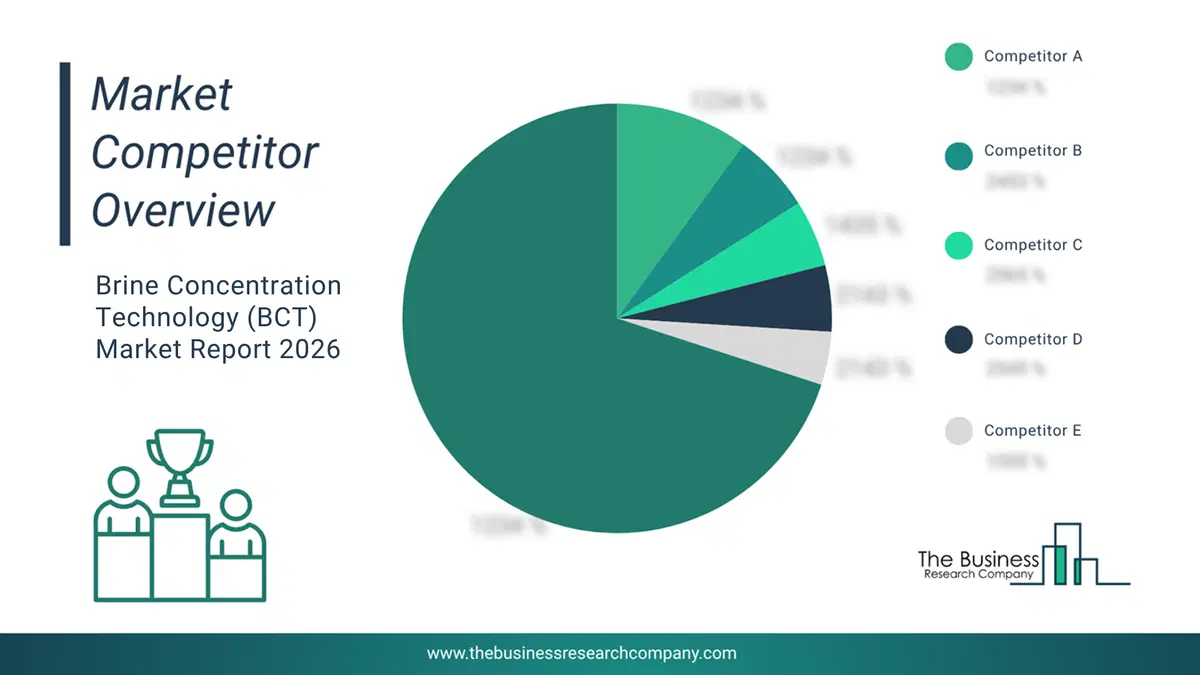
This chart is for illustrative purposes; the full report includes a detailed competitor analysis and comprehensive overview of the top 10 companies in the market.
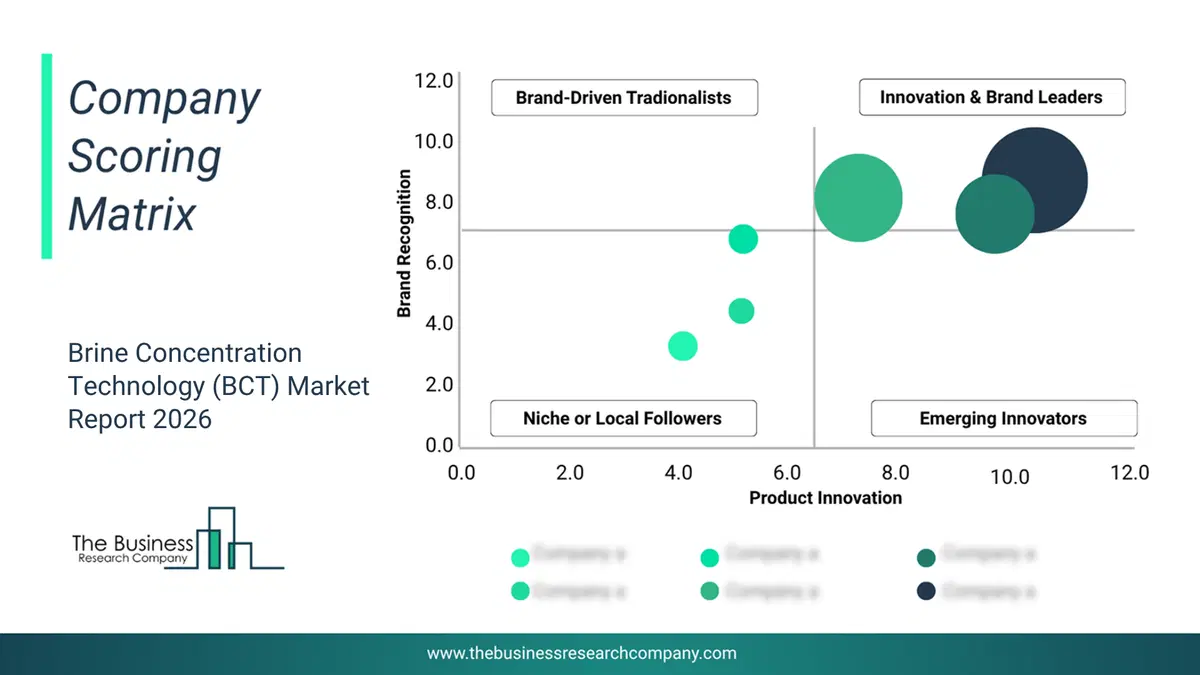
This chart maps companies by product innovation and brand strength, with bubble size indicating relative revenue, helping identify market leaders, challengers, and niche players. This is an illustrative chart; the full report provides a complete and accurate competitive analysis.
Global Brine Concentration Technology (BCT) Market Trends and Insights
Major companies operating in the brine concentration technology (BCT) market are adopting strategic partnership approaches to introduce the next generation of environmentally friendly brine concentration technology. Strategic partnerships refer to a process in which companies leverage each other’s strengths and resources in advancing the desalination industry by offering more sustainable and cost-effective solutions. For instance, in March 2023, Aquatech, a US-based provider of water and process technology solutions, partnered with Fluid Technology Solutions Inc., a US-based water treatment technology company. This partnership is geared towards enhancing and advancing brine concentration technology, with a focus on achieving high recovery rates, minimizing energy consumption, and attaining the lowest possible CO2 footprint while maximizing water and mineral recoveries. Aquatech and FTS are partnering to jointly provide advanced water treatment technology and process solutions across strategic sectors such as brine mining, lithium and critical minerals, inland desalination, and minimal or zero liquid discharge (MLD or ZLD).What Are Latest Mergers And Acquisitions In The Brine Concentration Technology (BCT) Market?
In April 2023, Alchemist Mining Inc., a Canada-based investment and technology solutions company, acquired LiTHOS Technology Corp. for an undisclosed amount. With this acquisition, Alchemist will be able to provide direct lithium extraction at scale for sustainable lithium production. LiTHOS Technologies Corp. is a Canada-based sustainable lithium production company that has investments in AcQUA, a patented wastewater solutions technology for selective purification and concentration of lithium-containing brines (direct lithium extraction; DLE) from continental brine reservoirs.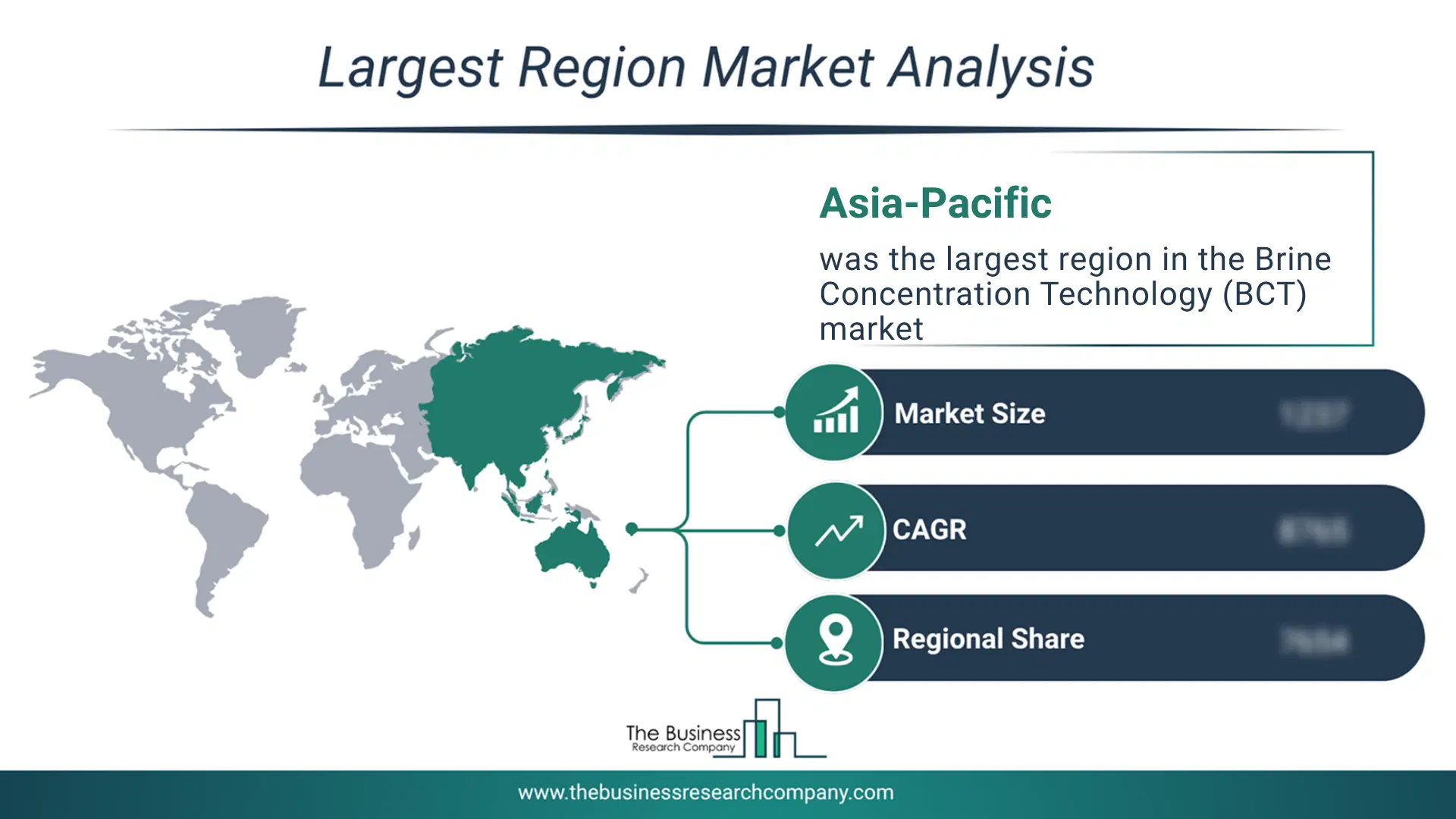
Regional Outlook
Asia-Pacific was the largest region in the brine concentration technology (BCT) market in 2025. The regions covered in this market report are Asia-Pacific, South East Asia, Western Europe, Eastern Europe, North America, South America, Middle East, Africa The countries covered in this market report are Australia, Brazil, China, France, Germany, India, Indonesia, Japan, Taiwan, Russia, South Korea, UK, USA, Canada, Italy, Spain.What Defines the Brine Concentration Technology (BCT) Market?
The brine concentration technology market consists of revenues earned by entities by providing chemical extraction, brine treatment services, closed circuit desalination services. The market value includes the value of related goods sold by the service provider or included within the service offering. The brine concentration technology market also includes sales of ammonium chloride, lithium chloride, and calcium bromide which are used in brine concentration technology. Values in this market are ‘factory gate’ values, that is the value of goods sold by the manufacturers or creators of the goods, whether to other entities (including downstream manufacturers, wholesalers, distributors and retailers) or directly to end customers. The value of goods in this market includes related services sold by the creators of the goods.How is Market Value Defined and Measured?
The market value is defined as the revenues that enterprises gain from the sale of goods and/or services within the specified market and geography through sales, grants, or donations in terms of the currency (in USD unless otherwise specified). The revenues for a specified geography are consumption values that are revenues generated by organizations in the specified geography within the market, irrespective of where they are produced. It does not include revenues from resales along the supply chain, either further along the supply chain or as part of other products.
This chart presents market attractiveness based on a quantitative evaluation of growth, competition, strategic alignment, and risk, offering a clear view of opportunity areas for decision-making. This chart is for illustrative purposes; the full report contains the complete analysis.

This chart highlights the Total Addressable Market (TAM) by estimating the maximum revenue opportunity using an assumption-driven approach, supporting strategic planning and opportunity sizing across markets. The chart is illustrative; the full report provides a more comprehensive analysis.
What Key Data and Analysis Are Included in the Brine Concentration Technology (BCT) Market Report 2026?
The brine concentration technology (bct) market research report is one of a series of new reports from The Business Research Company that provides market statistics, including industry global market size, regional shares, competitors with the market share, detailed market segments, market trends and opportunities, and any further data you may need to thrive in the brine concentration technology (bct) industry. The market research report delivers a complete perspective of everything you need, with an in-depth analysis of the current and future state of the industry.Brine Concentration Technology BCT Market Report Forecast Analysis
| Report Attribute | Details |
|---|---|
| Market Size Value In 2026 | $16.11 billion |
| Revenue Forecast In 2030 | $20.4 billion |
| Base Year For Estimation | 2025 |
| Actual Estimates/Historical Data | 2020-2025 |
| Forecast Period | 2026 - 2030 |
| Market Representation | Revenue in USD Billion and CAGR from 2026 to 2030 |
| Segments Covered | Technology, Type, End User |
| Regional Scope | Asia-Pacific, Western Europe, Eastern Europe, North America, South America, Middle East, Africa |
| Key Companies Profiled | Veolia Environnement S.A., Dow Inc., DuPont de Nemours Inc., SUEZ Group, Tetra Technologies Inc., Pall Corporation, Evoqua Water Technologies Corp, Hyflux Ltd., H2O Innovations Inc., Aquatech International LLC, IDE Technologies Ltd., Koch Separation Solutions Inc., Saltworks Technologies Inc., Synder Filtration Inc., Samco Technologies Inc., AquaChem Inc., Gradiant India Pvt Ltd., Oasys Water Inc., Lenntech B.V., Advent Envirocare Technology Pvt. Ltd, Duraflow LLC, Rosenblad Design Group Inc., Modern Water plc, Enviro Water Minerals Company Inc. |
| Customization Scope | Request for Customization |
| Pricing And Purchase Options | Explore Purchase Options |